
- Services
- Services
-
- Hire a Team
-
- Industry
- Company
- Company
-
- Case Study

Your website is your busiest salesperson. It works every hour, answers questions, and collects leads. As your business grows, you may ask a hard question: should we keep building on WordPress, or invest in something made just for us?
This guide compares custom website development with WordPress in plain language. First, you will see how each option works. Next, you will compare cost, speed, security, and scalability. Finally, you will get a simple way to decide. Non-technical owners get clear takeaways, and developers get the technical details.
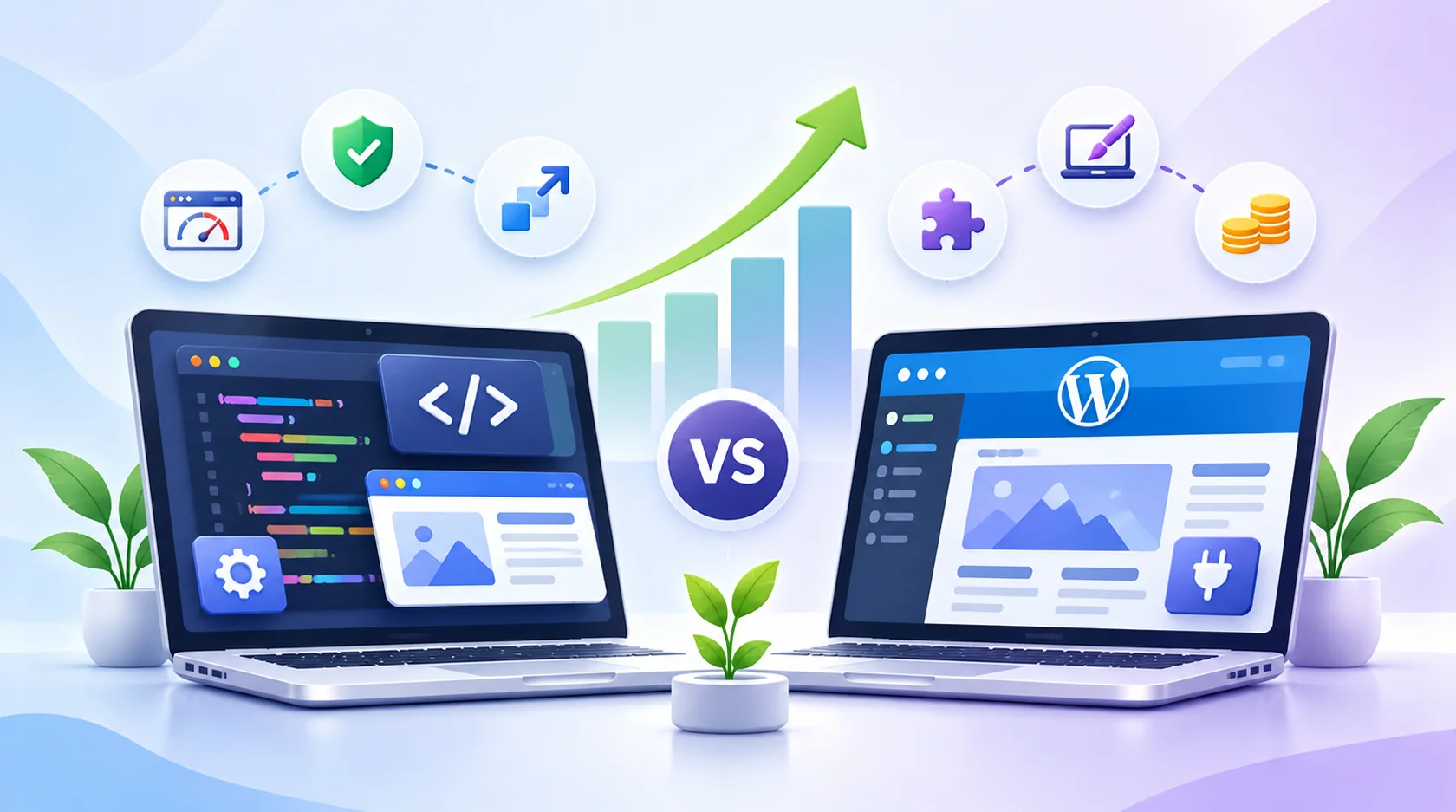
Quick answer: Custom website development gives you full control, unique features, and room to scale, but it costs more and takes longer. WordPress launches faster and costs less, and it fits most business sites. Choose WordPress for content-led sites with standard needs. Choose custom for complex logic, heavy integrations, or a product-style platform.
Custom website development means a team designs and builds your site around your exact needs. Developers write the code, plan the structure, and build only the features you require. You are not limited by a template or a plugin library.
In plain terms, it is like building a house to your own plans. You get exactly what you want. However, you pay for the design, the labor, and the upkeep.
WordPress is a free, open-source content management system. It gives you themes, plugins, and an easy editor. As of October 2026, it ran on 40.2% of all websites and held 58.7% of the market among sites with a known CMS. colorlib
In plain terms, it is like buying a ready-made house and customizing it. You move in quickly, and you can renovate with plugins and themes.
This is not always an either-or choice. Developers can build a custom theme and custom plugins on WordPress. They can also run WordPress as a back-end content system and build the front end separately, which is called headless. For example, our Next.js development services pair modern front ends with content platforms.
Use this table for a quick view. The sections below explain each row.
| Factor | Custom development | WordPress |
|---|---|---|
| Best for | Complex platforms, unique logic | Content sites, standard business needs |
| Launch speed | Slower | Faster |
| Upfront cost | Higher | Lower |
| Flexibility | Nearly unlimited | High, within plugin and theme limits |
| Security upkeep | You manage your own code | Frequent plugin and core updates |
| Editing ease | Depends on the build | Familiar, easy editor |
| Scalability | Designed for your needs | Scales with good hosting and care |
| Ownership | Full code ownership | Open source, with third-party plugins |
WordPress costs vary with scope. One 2026 guide lists DIY builds at about $500 to $2,000 per year, freelancer projects at $2,000 to $15,000, and agency projects at $10,000 to $50,000 or more. Another puts a typical WordPress business website at $8,000 to $20,000.
Custom builds cost more. One 2026 estimate puts a fully coded site, with no CMS template, at $10,000 to $30,000 with a freelancer and $30,000 to $100,000 or more with an agency. Complex platforms with logins, dashboards, and integrations cost far more.
One comparison says that for a standard business website, a custom build typically costs two to four times as much as a well-built WordPress equivalent. Sources vary, so treat all numbers as ballparks and ask for itemized quotes.
Launch is only the start. One guide suggests budgeting 10 to 30 percent of the initial build cost each year for maintenance and improvements. Another estimates WordPress maintenance at $500 to $3,000 per year. Custom sites need maintenance too, including dependency updates, hosting, and bug fixes.
WordPress usually launches faster, because themes and plugins cover many needs. Custom projects need discovery, design, development, and testing. Therefore, a simple WordPress site may take weeks, while a custom platform often takes months.
Speed affects both sales and search rankings. WordPress can be fast, but it depends on hosting, theme quality, and plugin load. One report says only 44% of WordPress sites pass all Core Web Vitals on mobile. A custom build loads only the code you need, so it often performs better. However, a well-tuned WordPress site can also perform well.
WordPress security deserves honest attention. Patchstack counted 11,334 new vulnerabilities in the WordPress ecosystem in 2025, up 42% from 7,966 in 2024, and 91% were in plugins. Only six were found in WordPress core. In other words, plugins are the main risk, not WordPress itself.
Speed matters here too. The median time from public disclosure to mass exploitation is now about five hours. Roughly 46% of reported vulnerabilities had no developer patch when they were disclosed. Therefore, keep plugins few, updated, and well chosen.
Custom sites avoid public plugin risks, but they are not automatically safe. Your team must write secure code, update dependencies, and test regularly. Bad custom code can be riskier than well-maintained WordPress.
WordPress needs steady updates. WordPress 7.0 shipped on May 20, 2026, with emergency 6.9.5 and 7.0.2 releases on July 17, 2026 to close a serious flaw. A security-only 7.0.3 release followed on August 6, 2026, fixing 12 vulnerabilities. A maintenance plan keeps you current. Our WordPress development services include this kind of care.
WordPress is flexible, but plugins can pile up. Each new feature may add another plugin, which adds risk and weight. Custom website development gives you exact features without that clutter. For example, a quoting tool, a customer portal, or a complex pricing engine fits naturally into a custom build.
Both options scale, but in different ways. WordPress scales with strong hosting, caching, and a clean setup. Custom platforms scale through architecture designed for your traffic and data. If you expect fast growth or heavy back-end logic, our custom web development services can plan for it from day one. For backend choices, see our guides on Node.js vs Python for backend development and React vs Vue.
WordPress has strong SEO tools and flexible URLs, and many marketers know it well. Custom sites can rank just as well when developers handle rendering, speed, structured data, and clean URLs. Either way, strategy matters more than platform. Our SEO services work with both approaches.
Editors often prefer WordPress because the interface is familiar. Custom sites can offer easy editing too, but only if the team builds a good admin area or connects a headless CMS. Always ask how your marketing team will update pages.
Choose WordPress If You Need:
Choose Custom Website Development If You Need:
Many growing businesses mix both. For example, they run WordPress for marketing pages and a custom app for the product. They also use headless WordPress with a custom front end. This approach keeps editing easy while allowing custom features. Check our eCommerce web design services if you also sell online.
Skip long debates and answer these questions. Your answers point to the right option.
Pick a team that can build both. Then you get honest advice instead of a sales push. Our guide on choosing a custom software development company in the USA explains how to vet vendors. You can also read about choosing a backend development company and offshore software development.
Neither wins every time. Custom website development suits complex platforms, heavy integrations, and unique features. WordPress suits content-led sites and faster, cheaper launches. The right choice depends on your needs, budget, and team.
Custom builds usually cost two to four times as much as a comparable WordPress site. Agency-built custom sites often start around $30,000, while WordPress agency projects often range from $10,000 to $50,000. At AssaptR, we start with a clear scope and give you an itemized estimate. Schedule a free call to discuss your project.
Yes, with good habits. WordPress core is well maintained, and most risk comes from plugins. Keep plugins few, update often, and use quality hosting and backups. A maintenance plan helps.
Yes. Rankings depend on speed, content, structure, and links, not on the platform. A custom site needs developers who handle rendering and structured data well.
Yes. Many business launch on WordPress, then add custom features or a custom front end as they grow. Plan clean URLs and content structure from the start, so migration stays smooth.
Headless WordPress uses WordPress only to manage content. A separate front end, often built with React or Next.js, displays it. This keeps editing easy while giving developers more control over speed and design.
AssaptR builds on both sides of this decision. Our team offers WordPress development services and custom web development services, so we can recommend the better fit honestly. We also support conversion rate optimization services and SEO. Review our case studies before you talk to us.
Yes. If you already have a team, you can add skilled developers to it. AssaptR offers flexible options to hire WordPress developers or explore our wider hire talent options.
Start with a short conversation. Schedule a free call or use our contact page to share your goals, timeline, and budget range. Then we will help you shape the scope and suggest the next step.
The choice between custom website development and WordPress comes down to your goals, your budget, and your growth plans. WordPress rewards teams that want speed, easy editing, and a lower cost. Custom development rewards teams with complex logic, heavy integrations, or a product-style platform.
Start with what your site must do. Then match the tool to the job. Many businesses end up with a hybrid, and that is a smart answer too.
AssaptR helps growing businesses build websites that fit how they work. Explore our custom web development services, contact our team, or schedule a free call to plan your project.
Neha is a web technology enthusiast and content contributor at AssaptR, specializing in software development, custom web solutions, eCommerce, and digital marketing. Her articles focus on the latest industry trends, best practices, and actionable strategies that help businesses build secure, scalable, and high-performing digital products.
2. What Is Custom Website Development, and What Is WordPress?
2.1. Custom Website Development
2.3. The Middle Path: Custom-Built WordPress and Headless Setups
3. Custom Website Development vs WordPress: Side-by-Side Comparison
4.2. What Custom Development Costs
5. Speed, Security, and Maintenance
6. Flexibility, Scalability, and SEO
7. When to Choose WordPress and When to Choose Custom
8. How to Decide: A Simple Framework
10. Final Thoughts on Custom Website Development vs WordPress
WhatsApp us