
- Services
- Services
-
- Hire a Team
-
- Industry
- Company
- Company
-
- Case Study

Your backend is the engine behind your app or website. It stores data, runs business rules, and connects payments, APIs, and AI tools. If it fails, customers feel it right away.
That is why choosing a backend development company is a high-stakes decision. A strong partner helps you launch faster and scale safely. A weak one leaves you with slow systems, security gaps, and expensive rewrites.
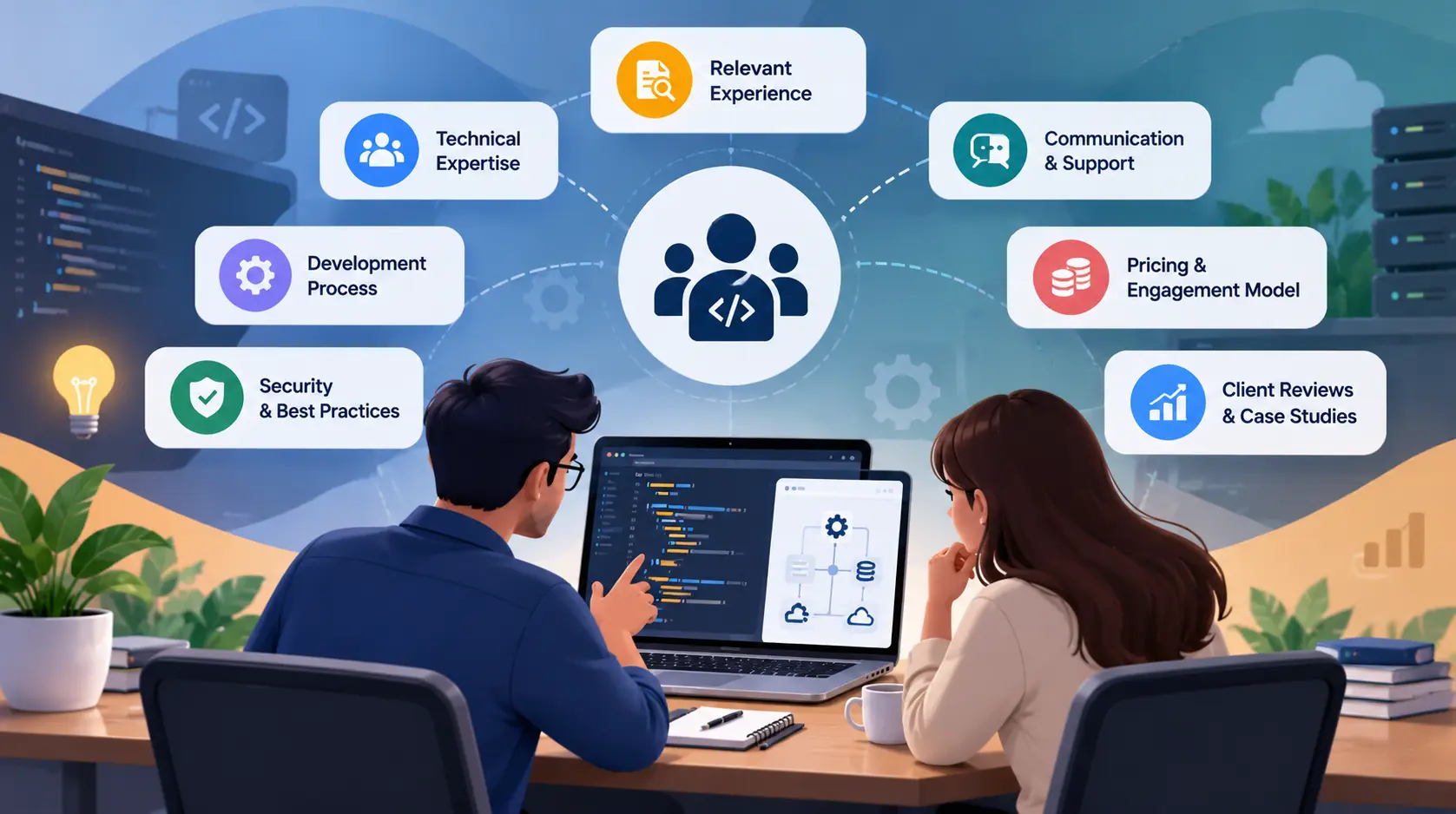
This guide gives you a clear eight-step process. First, non-technical founders get plain-language checks. Next, technical leads get deeper questions to ask. As a result, your whole team can judge vendors with confidence.
Quick answer: To choose a backend development company, define your scope first. Then check technical fit, real case studies, security practices, communication habits, and contract terms. Finally, run a small paid pilot before you commit to the full project.
A backend development company builds the hidden systems that power your product. Customers never see this layer, but they depend on it every second.
Typical work includes:
In plain terms, the front end is the shop window. The backend is the warehouse, the cash register, and the security system behind it.
Learn more about AssaptR’s Backend development services.
Backend mistakes are costly because they hide deep in the system. For example, a poor database design may work fine at 1,000 users. At 100,000 users, however, it can crash.
Complex projects need senior expertise in backend architecture, database design, and security, because mistakes here are expensive and hard to undo. Therefore, the cheapest bid is rarely the best deal.
The right partner also affects your speed. A good team ships working features every few weeks. A poor one disappears for months and returns with something that barely works. For that reason, take time to evaluate before you sign.
Before you contact anyone, write down what you need. Vendors can only give accurate advice when your goals are clear.
For business owners: Answer these simple questions first.
For technical leads: Add details such as existing systems, required integrations, expected traffic, data volumes, and compliance needs.
A clear brief saves money. Moreover, it makes proposals easier to compare, because every vendor prices the same work. Even a two-page document helps. If you need help shaping the scope, a good partner will offer a discovery workshop.
Not every company is strong in every technology. So confirm that the team has real depth in the stack you need.
Ask which languages and frameworks they use daily. For example, they might work in Python with Django or FastAPI, or in Node.js with NestJS or Express. If you are unsure which is right, our guide on Node.js vs Python for backend development explains the trade-offs.
Developers on your side should probe for these signs of maturity:
A confident team answers with specifics. A weak team answers with buzzwords.
If your product includes AI, check for that skill too. Our Python development services and AI and ML services show how backend and AI work fit together.
Proof beats promises. Therefore, look for evidence that the company has solved problems like yours.
Strong case studies include the problem, the approach, and measurable results. Weak ones show only logos and screenshots. Review our case studies to see the difference.
Also check for experience in your industry. A team that knows finance, healthcare, or retail understands the rules and risks that come with it.
Ask for two or three client references. Then speak with them directly. Useful questions include:
Also check independent review sites such as Clutch and Google. Look for patterns, not single complaints.
Your backend holds your most sensitive data. So security cannot be an afterthought.
For business owners: Ask whether the company follows recognized security practices. Look for clear policies on data access, staff screening, and incident response.
For technical leads: Probe deeper with these checks.
Moreover, confirm who owns the data and the code. Your contract should state that you own both. If a vendor avoids this topic, treat it as a warning sign.
Many projects fail because of poor communication, not poor code. So judge how a company talks to you before the contract begins.
Notice these early signals:
Time zones matter as well. One 2026 cost guide estimates that real-time time zone overlap justifies a 10 to 20 percent rate premium. For some teams, that overlap is worth it. For others, a few hours of daily overlap is enough. Our guide to offshore software development explains how to make distributed teams work.
Finally, insist on regular demos. Seeing working software every one to two weeks keeps everyone honest.
Companies usually offer three models. Each one suits a different situation.
You pay one agreed amount for a defined scope. This works well for small, clear projects. However, changes can become expensive. One guide reports that about 35 percent of fixed-price offshore projects hit scope disputes, with change orders averaging 15 to 25 percent of the original contract.
You pay for the hours worked. Consequently, it suits projects where requirements will evolve. Hourly rates under this model run about 15 to 25 percent higher than fixed-price rates, because the vendor takes on more flexibility. Set a monthly cap to keep costs under control.
You get a full-time team that works as an extension of your own. Retainers favor predictability, hourly billing favors flexibility, and hybrid models blend both for evolving scopes. This option fits long-term products. You can also hire Python developers or hire NextJS developers individually if you only need to fill gaps
Price matters, but the lowest quote often hides extra costs. Therefore, compare total cost of ownership, not just the hourly rate.
Backend developer rates worldwide range from about $20 to $350 per hour, with most production work falling between $45 and $140. Region is the single biggest cost lever. A very low bid, therefore, should raise questions about experience and quality.
Ask each vendor for a line-by-line estimate. Then compare the assumptions behind each number. If two quotes differ widely, one of them has misunderstood the scope.
Launch day is the beginning, not the end. Your backend needs updates, monitoring, and security patches for years.
Before signing, confirm these points:
Strong handover rules protect you from lock-in. In short, you should always be able to take your system elsewhere.
Use this scorecard to compare vendors. Rate each one from 1 to 5, then multiply by the weight.
| Criteria | What good looks like | Suggested weight |
|---|---|---|
| Technical fit | Proven skills in your exact stack | 25% |
| Relevant case studies | Measurable results in similar projects | 20% |
| Security practices | Clear policies, audits, and compliance support | 15% |
| Communication | Fast replies, honest risk flags, regular demos | 15% |
| Pricing clarity | Detailed estimate with stated assumptions | 10% |
| Support and handover | Warranty, docs, and code ownership | 10% |
| Reviews and references | Consistent positive feedback | 5% |
Bring this list to every vendor call. The answers reveal a lot.
That last question deserves emphasis. A one- to two-week pilot shows you how the team works before you commit your full budget.
Some warning signs appear early. Watch for them.
You can also compare vendor types. Each has strengths.
An agency offers a full team with developers, QA, and project managers. It suits mid-size and larger projects. Consequently, it costs more than a single freelancer, but it carries less risk.
A freelancer works well for small, well-defined tasks. However, you carry more risk if the person becomes unavailable. Freelancer rates for experienced backend developers average about $73 to $128 per hour in 2026. golance
An in-house team gives you the most control. It also takes the longest to build and costs the most in salaries and hiring time. Many growing companies blend in-house leaders with an agency for extra capacity.
Rates vary by region, experience, and project type. Fixed-price projects depend on scope, so request a detailed quote.
A simple backend with a few APIs can take four to eight weeks. A complex platform with integrations, security, and scale needs can take several months. A discovery phase gives you a realistic timeline.
Both can work. Local teams offer easy meetings and shared context. Offshore teams offer cost savings and broad talent. Choose based on your communication needs, budget, and the vendor’s track record.
A front-end team builds what users see and click. A backend team builds the systems behind it, such as databases, APIs, and security. Many companies, including AssaptR, provide both so the pieces fit together.
Yes, if you plan for it. Insist on code ownership, clear documentation, and access to your cloud accounts. These steps make a future handover much smoother.
It depends on your product. Python suits AI and data-heavy apps. Node.js suits real-time apps and JavaScript-first teams. A good vendor will recommend a stack based on your goals, not their own habits.
Choosing a backend development company comes down to fit, proof, and trust. Define your scope clearly. Then check technical depth, security habits, real references, and contract terms. Finally, test the relationship with a small pilot.
A good partner does more than write code. They challenge weak ideas, flag risks early, and build systems that grow with you.
AssaptR builds secure, scalable backends for startups and established businesses. Explore our custom web development services, browse our hire talent options, contact our team, or schedule a free call to discuss your project.
Neha is a web technology enthusiast and content contributor at AssaptR, specializing in software development, custom web solutions, eCommerce, and digital marketing. Her articles focus on the latest industry trends, best practices, and actionable strategies that help businesses build secure, scalable, and high-performing digital products.
WhatsApp us