
- Services
- Services
-
- Hire a Team
-
- Industry
- Company
- Company
-
- Case Study

Your backend is the engine behind your website or app. It stores data, runs business rules, and talks to payment tools, APIs, and AI models. Choosing the wrong language can slow your launch and raise your costs for years.
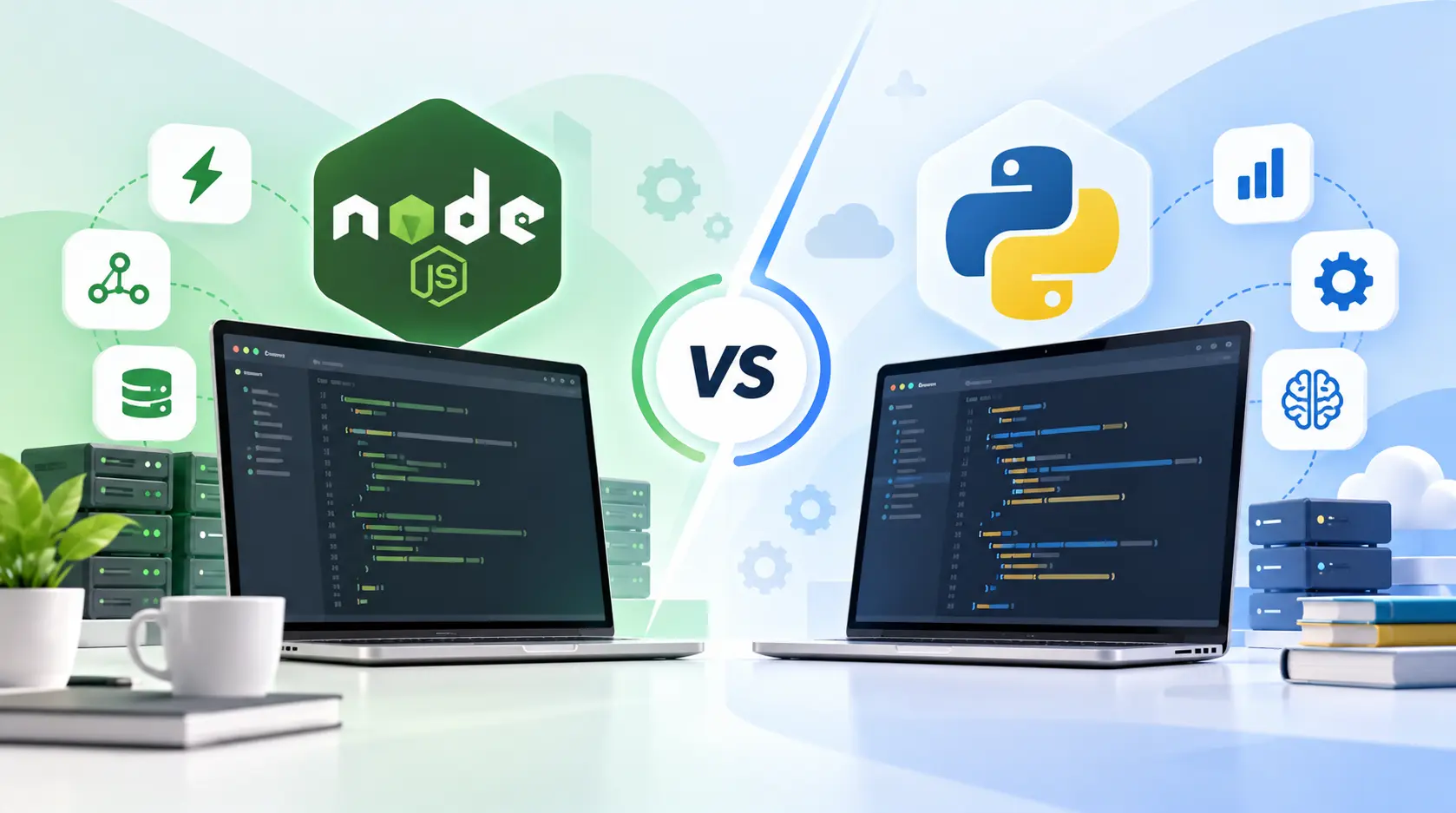
This guide compares Node.js vs Python in plain language. First, non-technical founders get clear takeaways. Next, developers get the technical details that matter. By the end, you will know which option fits your project.
Quick answer: Choose Node.js for real-time apps, high-traffic APIs, and teams that already use JavaScript. Choose Python for AI, machine learning, data-heavy products, and fast prototyping. Many growing companies use both.
Python is a general-purpose programming language known for readable code. Developers use it for web apps, automation, data science, and AI. Popular backend frameworks include Django, FastAPI, and Flask.
Node.js is different. It is not a language but a runtime. It is an open-source, cross-platform JavaScript runtime built on Google’s V8 engine. In other words, Node.js lets developers run JavaScript on the server. Express, Fastify, and NestJS are common frameworks.
Here is a simple way to picture it. Python is like a Swiss Army knife that handles many jobs well. Node.js, on the other hand, is like a fast delivery van built to handle many small requests at once.
Learn more about AssaptR’s Backend development services.
Use this table for a quick view. The sections below explain each row.
| Factor | Node.js | Python |
|---|---|---|
| Best for | Real-time apps, APIs, streaming | AI, data, automation, MVPs |
| Raw API speed | Usually faster | Usually slower |
| Heavy computation | Needs worker threads | Strong libraries and tools |
| Main frameworks | Express, Fastify, NestJS | Django, FastAPI, Flask |
| Learning curve | Easy if you know JavaScript | Very beginner-friendly |
| AI and ML tools | Growing | Industry standard |
| Full-stack sharing | One language front to back | Separate front-end language |
| Hiring pool | Very large | Very large |
Performance is where most debates start. The honest answer depends on what your app does.
Node.js handles many simple requests very efficiently. TechEmpower’s framework benchmarks show Node.js frameworks like Fastify beating Python frameworks like FastAPI or Django on requests per second, often by two times or more. Therefore, Node.js often suits busy APIs and chat-style apps.
However, benchmarks are not the full story. Most business apps spend their time waiting on databases and third-party services. As a result, the gap rarely decides the winner on its own.
Python has historically struggled with parallel CPU work because of a lock called the GIL. That is changing. Python 3.14 made free-threaded mode officially supported, with single-thread overhead of roughly 5 to 10 percent. Still, the GIL stays on by default, and library support for the free-threaded build varies. So treat it as promising, not automatic.
Both options can scale to millions of users. They simply scale in different ways.
Node.js uses an event-driven model. In plain terms, one process juggles thousands of waiting connections without blocking. Consequently, it handles chat, notifications, and live dashboards well. For CPU-heavy tasks, however, developers must use worker threads or separate services.
Python scales mainly through multiple processes, async code, and background workers. Tools like Celery handle long tasks. Moreover, FastAPI supports async code, which narrows the gap for I/O-heavy APIs.
In practice, architecture matters more than language. A well-designed Python system beats a poorly designed Node.js one, and vice versa. If you plan for growth, our custom web development services cover architecture, caching, and cloud setup from day one.
A strong ecosystem saves months of work. Both languages have one.
Node.js uses npm, one of the largest package registries in the world. You can find a package for almost any task. In addition, sharing code between your front end and backend is easy. Teams using React or Next.js often pick Node.js for this reason. You can see how we work with these tools on our Next.js development services page.
Python’s ecosystem shines in data, science, and automation. FastAPI is now the leading choice for new Python API projects, while Django remains a foundation for complex web applications. Django also ships with an admin panel, authentication, and an ORM, so it speeds up content-heavy products.
Here is a simple product endpoint in each stack. First, Node.js with Express:
import express from “express”;
const app = express();
app.get(“/products/:id”, (req, res) => {
res.json({ id: req.params.id, name: “TrailShield Jacket” });
});
app.listen(3000);
Next, Python with FastAPI:
from fastapi import FastAPI
app = FastAPI()
@app.get(“/products/{product_id}”)
def get_product(product_id: int):
return {“id”: product_id, “name”: “TrailShield Jacket”}
Both are short and readable. Notice, however, that FastAPI validates the product ID type automatically, while Express needs extra code or a library for that.
Python is famously easy to read. Its clean syntax helps new developers become productive quickly. Consequently, it works well for small teams and mixed-skill groups.
Node.js is easy too, provided your team already knows JavaScript. In that case, the same developers can build both the front end and the backend. This overlap can cut hiring needs and speed up handoffs.
Developer supply is strong in both camps. The 2025 Stack Overflow survey found JavaScript used by 66 percent of respondents and Python by 57.9 percent. Therefore, you can find talent for either. If you need extra hands, you can hire Python developers or hire NextJS developers on a flexible basis.
This is where Python pulls ahead. Nearly every major AI and data library targets Python first. That includes tools for model training, data analysis, and LLM workflows.
Python’s growth reflects this. Its seven-point jump in the 2025 Stack Overflow survey was attributed to AI and data science.
So if your product includes recommendations, forecasting, document analysis, or AI agents, Python is usually the safer base. Our Python development services and AI and ML services work together for these projects. For instance, we build with generative AI and AI agent development.
Node.js can still call AI services through APIs. Therefore, it works fine for apps that simply use a hosted model. It is less suited to building or training models.
Some products need instant updates. Examples include chat, live tracking, multiplayer features, and trading dashboards.
Node.js is the natural fit here. Its event-driven design and WebSocket support make live features simple. In addition, one language across front end and backend speeds up development.
Python can handle real-time work too, especially with async frameworks. However, it takes more care to reach the same smoothness. For standard REST or GraphQL APIs, either option works well.
Every backend needs regular updates. Security depends on your process more than on your language.
Node.js has a clear support calendar. Node.js 20 stopped receiving security patches on April 30, 2026, and Node.js 26 enters long-term support on October 28, 2026. Meanwhile, the project is moving to one major release per year starting with Node.js 27. As a result, upgrade planning becomes easier.
Python also follows a predictable yearly cycle. Django adds strong built-in protections against common attacks. Even so, both ecosystems need dependency audits, because third-party packages carry most of the risk.
Whichever you choose, run on a supported version and patch often. Unsupported runtimes are a common cause of avoidable breaches.
Both languages are free and open source. Therefore, your costs come from developer time, hosting, and maintenance.
Python often wins on speed for MVPs. Django’s built-in features and Python’s readable code help teams ship fast. Node.js wins when your team already uses JavaScript, because one team covers more of the stack.
Hosting costs are usually similar. Node.js may use fewer servers for high-concurrency apps. Python may save money when it replaces several separate data tools. Overall, the right choice is the one your team can build and maintain efficiently. For ideas on controlling budgets, see our guide on offshore software development costs and benefits.
Use these quick rules. Each one answers a common question.
Finance and healthcare products often rely on Python for analytics and reporting. Retail and marketplace products often lean on Node.js for speed and real-time updates. Explore how we support finance, healthcare, and retail businesses.
Yes, and many teams do. This approach is common in modern architecture.
For example, Node.js can run your main API and real-time features. Meanwhile, a Python service can handle recommendations, document processing, or AI tasks. The two talk to each other through APIs or message queues.
This setup keeps each tool in its strongest role. However, it adds complexity. Small teams should start with one language and add the second only when a clear need appears.
Follow these steps to reach a confident choice.
Many teams repeat the same errors. Avoid these.
For simple, high-volume requests, Node.js is usually faster. However, real-world speed also depends on your database, caching, and code quality. For most business apps, both are fast enough.
Yes. Python powers backends at companies of every size. Django and FastAPI both handle production workloads well, and Python is especially strong when your product includes data or AI.
Shopify is often easier to budget, because most costs sit in one monthly bill. WooCommerce can be cheaper if you already have hosting and technical skills.
It depends on the product. Python suits AI and data startups. Node.js suits startups building real-time or JavaScript-heavy products. Either way, pick the one your team can ship with fastest.
Yes, but it takes planning. A safer path is to keep clean API boundaries, so you can replace or add services over time instead of rewriting everything.
Use a supported long-term-support version. Node.js 24 is the main production choice today, and Node.js 26 becomes the long-lived target once it enters LTS in October. Avoid any version that no longer receives security patches.
The Node.js vs Python decision has no universal winner. Node.js rewards teams building real-time, high-traffic, JavaScript-first products. Python rewards teams building AI, data, and fast-moving MVPs.
Start with your product goals, your team’s skills, and your growth plans. Then choose the stack that removes the most friction. If you want a second opinion, we can help.
AssaptR builds backends in both ecosystems. Explore our custom web development services, contact our team, or schedule a free call to talk through your project.
Neha is a web technology enthusiast and content contributor at AssaptR, specializing in software development, custom web solutions, eCommerce, and digital marketing. Her articles focus on the latest industry trends, best practices, and actionable strategies that help businesses build secure, scalable, and high-performing digital products.
2. What Are Node.js and Python for Backend Development?
3. Node.js vs Python: Side-by-Side Comparison
5. Scalability and Concurrency
6. Ecosystem, Frameworks, and Libraries
8. AI, Machine Learning, and Data Projects
12. Which Should You Choose? By Project Type
13. Can You Use Both Node.js and Python?
14. How to Decide in Five Steps

WhatsApp us