
- Services
- Services
-
- Hire a Team
-
- Industry
- Company
- Company
-
- Case Study

Every website, app, and online store keeps its data somewhere. Orders, customers, products, messages, and logins all live in a database. The type of database you choose affects speed, cost, and how easily your product can grow.
That is why founders and developers keep asking about the difference between SQL and NoSQL databases. This guide explains it in plain language. First, you will see how each type works. Next, you will compare them side by side and learn when to use each. Non-technical readers get clear takeaways, and developers get the technical details.
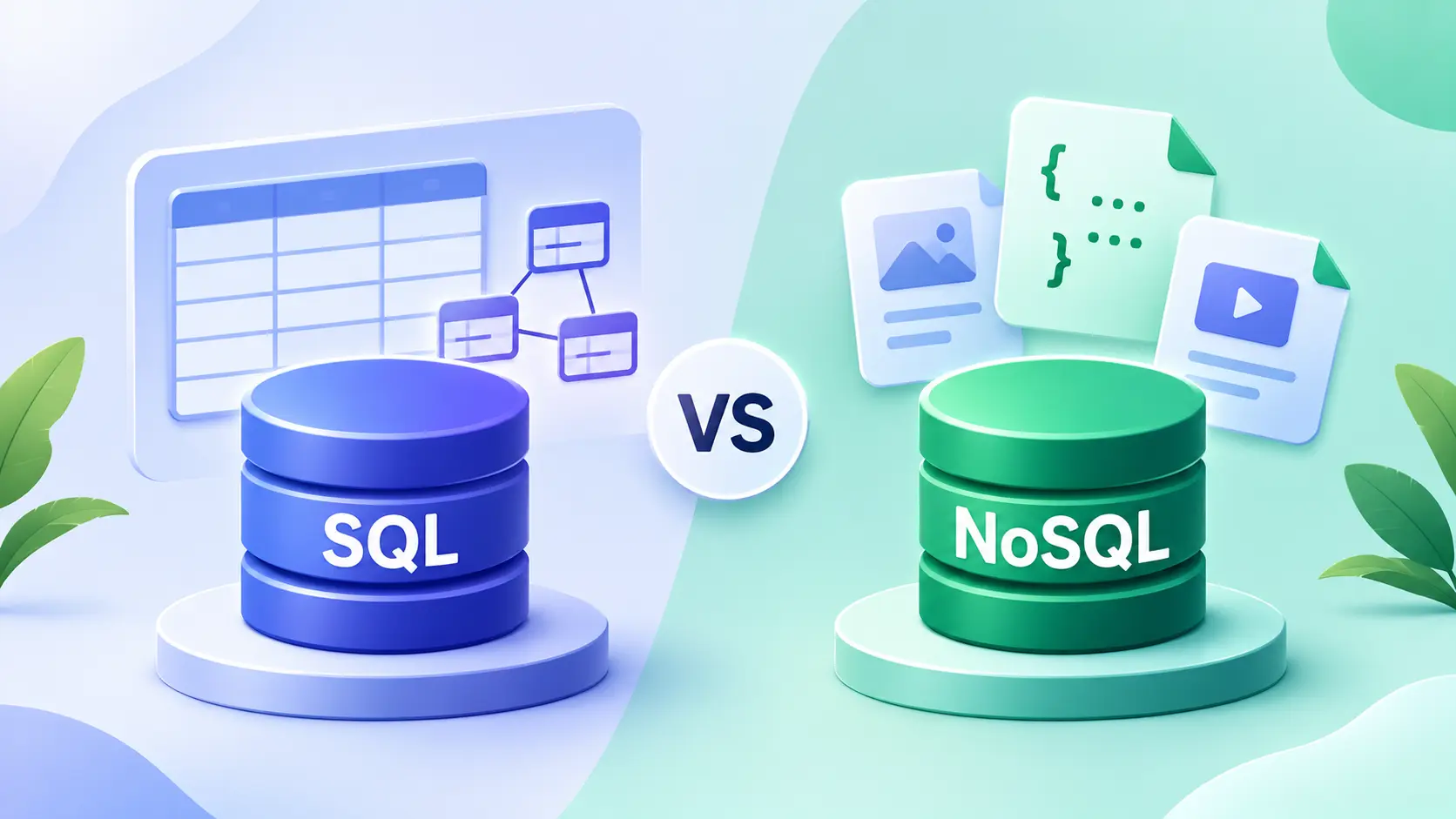
Quick answer: The difference between SQL and NoSQL databases comes down to structure. SQL databases store data in related tables with a fixed schema and strong consistency. NoSQL databases store data in flexible formats, such as documents, key-value pairs, columns, or graphs, and often scale out across many servers. Many modern businesses use both.
A SQL database is a relational database. It stores data in tables with rows and columns, and it uses the SQL language to read and change that data. Examples include PostgreSQL, MySQL, and SQL Server.
A NoSQL database is any database that does not use the classic table model. The name often means “not only SQL.” Examples include MongoDB, Redis, Cassandra, DynamoDB, and Neo4j.
Think of SQL as a well-organized spreadsheet system. Every sheet has fixed columns, and sheets link to each other through shared IDs. Think of NoSQL as a set of flexible folders. Each folder can hold different kinds of papers, and you can add new kinds anytime.
| Factor | SQL databases | NoSQL databases |
|---|---|---|
| Data model | Tables, rows, columns | Documents, key-value, wide-column, graph |
| Schema | Defined up front | Flexible or optional |
| Query language | SQL, standardized | Varies by database |
| Consistency | ACID transactions | Often BASE, with options |
| Scaling | Usually vertical, with replication | Often horizontal |
| Best for | Structured, related data | Flexible, high-volume, or specialized data |
SQL databases organize data into tables, such as customers, orders, and products. Each table has defined columns. Keys connect the tables, so one order points to one customer. The schema is enforced when you write data, which keeps records clean.
SQL databases use the ACID model: atomicity, consistency, isolation, and durability. In plain terms, a transaction either completes fully or not at all. For example, a payment never deducts money without also recording the order. That safety is why banks and stores trust SQL for money-related data.
Here is an order lookup in SQL. The database joins two tables:
sql
SELECT o.id, c.name, o.total
FROM orders o
JOIN customers c ON c.id = o.customer_id
WHERE o.status = ‘paid’;
In a document database such as MongoDB, the same order often lives in one document:
json
{
“_id”: “order_1001”,
“customer”: { “name”: “Ava Patel”, “email”: “ava@example.com” },
“items”: [{ “sku”: “TS-01”, “qty”: 2 }],
“status”: “paid”,
“total”: 58.00
}
The SQL version keeps data in separate tables and combines them when needed. The document version stores related data together, so one read returns everything.
NoSQL covers four main models:
NoSQL databases usually let each record have different fields. For example, a clothing product and a laptop can sit in the same collection with different attributes. As a result, teams can change the data shape without a heavy migration.
Many NoSQL systems follow the BASE model, which stands for basically available, soft state, and eventually consistent. It prefers availability over perfect consistency of replicated data. In practice, replicas may disagree for a short time, then catch up. That trade-off helps speed and scale.
SQL enforces structure when data is written. NoSQL usually enforces it in the application, or not at all. Therefore, SQL protects data quality, while NoSQL gives you speed of change.
SQL gives strong ACID guarantees by default. Note one detail: MySQL is ACID compliant only with certain storage engines, such as InnoDB, while PostgreSQL is always ACID compliant. NoSQL varies by product. Some, such as MongoDB, now support transactions, but strong consistency often costs some speed.
Relational databases traditionally scale vertically, which means upgrading one server, and they also support replication and sharding. NoSQL systems are often designed for horizontal scaling across many servers. This difference matters most at very large scale
SQL is a standard language, so skills carry across products. It handles joins and reporting very well. NoSQL databases use their own query tools. They excel at fast lookups, but complex cross-record queries take more work.
Neither type is always faster. Each wins at its home workload. A key-value store answers simple lookups very quickly, while a SQL database handles complex reports better. Therefore, match the database to the access pattern.
Both types have free open-source options and paid managed services. For example, MongoDB Atlas offers a free tier, a Flex tier capped at $30 per month, and dedicated clusters starting around $57 per month. Costs depend on data size, traffic, and how much your team runs itself. Always compare total cost, not just license fees.
Common examples include order processing, ledgers, inventory with rules, and anything auditors read.
An online store might use a SQL database for orders and payments, where accuracy is non-negotiable. It might use a document database for product catalogs, where attributes vary by product type. It might also use a key-value store for sessions. This approach is called polyglot persistence.
Industry Examples
Finance and healthcare lean toward SQL for transactional safety. Retail and media often mix both. See how we support finance, healthcare, and retail businesses.
The old “SQL versus NoSQL” fight is fading. Relational engines grew indexed JSON columns, so documents can live inside tables. Document stores added transactions and schema validation. Distributed SQL brought the relational model to horizontal scale. The boundary is now more like a gradient than a fence.
PostgreSQL leads developer adoption. It topped the 2025 Stack Overflow Developer Survey at 55.6% overall and 58.2% among professional developers. It also handles JSON, geospatial data, and now vector search. In fact, vector search has moved into general-purpose engines, so fewer teams need a separate vector database. That matters for AI features. Our AI and ML services can help you plan data for AI projects.
NoSQL remains strong where it fits. MongoDB 8.3 is the current stable release as of May 2026, and it remains the leading document database. Redis, Cassandra, DynamoDB, and Neo4j each lead in their own niches. Therefore, “NoSQL” still matters. It simply works best as a targeted tool.
Most real systems at scale use both types. A relational core handles transactions, a document store handles content, and a key-value cache speeds up reads. As a result, the best question is not “which type?” but “which job does each database do?”
Use these questions to guide the choice:
For new projects without special needs, many teams default to PostgreSQL and add specialized databases later. One 2026 analysis even says to default to PostgreSQL unless you have a specific reason to deviate. That reason might be existing MySQL infrastructure, extreme write volume, or a graph-shaped problem.
If you are unsure, ask your development partner to explain the trade-offs for your product. Our guides on choosing a backend development company, Node.js vs Python for backend development, and choosing a custom software development company in the USA can help. If your store connects to back-office systems, see how to integrate Shopify with ERP systems. Also keep backups healthy with our website maintenance checklist for 2027.
The difference between SQL and NoSQL databases is the data model. SQL uses related tables with a fixed schema and ACID transactions. NoSQL uses flexible models, such as documents or key-value pairs, and often favors scale and speed. AssaptR’s backend team can help you pick the right fit for your product.
Neither is better for every case. SQL suits structured, transactional data. NoSQL suits flexible, high-volume, or specialized data. Many businesses use both.
It depends on the workload. Key-value and document stores are very fast for simple lookups and high write volume. SQL databases are strong for complex queries and reports. Good design and indexing matter more than the label.
Yes. Modern relational databases, including PostgreSQL, store and index JSON. Therefore, many teams keep flexible data inside a SQL database instead of adding a second system.
Some do. MongoDB, for example, supports multi-document transactions. However, support and guarantees vary by product, so check the details before you rely on them.
Most startups do well with PostgreSQL, because it handles relational and JSON data in one system. Add NoSQL tools later for specific needs, such as caching or event streams.
AssaptR builds web platforms and backends for growing businesses, with services across custom web development and Python development. Our team can help you design your data layer alongside your application. Review our case studies before you talk to us.
Yes. If you already have a team, you can add skilled developers to it. AssaptR offers flexible options to hire Python developers or explore our wider hire talent options.
Start with a short conversation. Schedule a free call or use our contact page to share your product, data needs, and goals. Then we will help you shape the scope and suggest the next step.
The difference between SQL and NoSQL databases is not about old versus new. It is about structure, consistency, and scale. SQL protects structured, related data with strong guarantees. NoSQL offers flexible models and horizontal scale for specific jobs. In 2026, the two worlds overlap more than ever.
Start with your data and your workload. Pick the simplest option that meets your needs. Then add specialized databases only when a real problem demands them.
AssaptR helps businesses design backends that scale with them. Explore our custom web development services, contact our team, or schedule a free call to plan your data layer.
Neha is a web technology enthusiast and content contributor at AssaptR, specializing in software development, custom web solutions, eCommerce, and digital marketing. Her articles focus on the latest industry trends, best practices, and actionable strategies that help businesses build secure, scalable, and high-performing digital products.
2. What Is the Difference Between SQL and NoSQL Databases?
2.2. The Differences at a Glance
3.1. Tables, Keys, and Schemas
3.4. Strengths and Limits of SQL
4.3. BASE and Eventual Consistency
4.4. Strengths and Limits of NoSQL
5. SQL vs NoSQL: Key Differences Explained
5.2. Consistency and Transactions
6. When to Use SQL and When to Use NoSQL
7. The Lines Are Blurring in 2026
WhatsApp us