
- Services
- Services
-
- Hire a Team
-
- Industry
- Company
- Company
-
- Case Study

Modern businesses need web applications that can handle complex operations, large amounts of data, and growing user demands. From customer portals to enterprise dashboards, these applications must remain reliable as businesses expand.
That is why many companies turn to Angular development services. Angular provides a structured framework for building dynamic, scalable, and maintainable web applications. It also offers tools that support development teams throughout the application lifecycle.
In this guide, we first explore the benefits of Angular for enterprise applications. Then we cover its common business use cases and what companies should consider before choosing it.
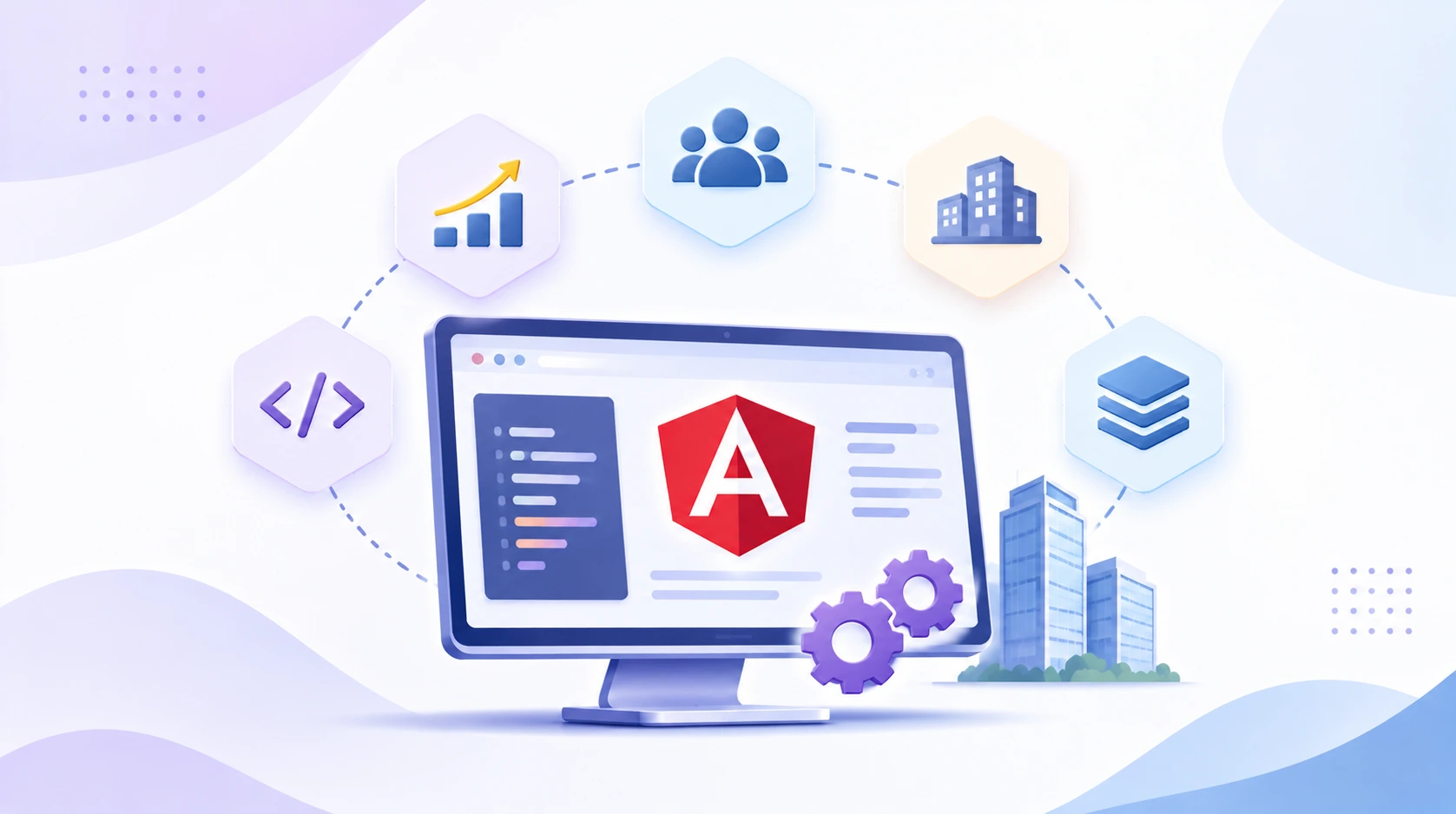
Angular is an open-source web application framework maintained by Google. It uses TypeScript and also provides tools for building interactive web applications.
Unlike a basic website, an enterprise application often includes multiple features and user roles. For example, it may have dashboards, reporting tools, payment workflows, and third-party integrations.
Angular helps developers organize these features into reusable components. As a result, teams can build applications with a consistent structure.
Businesses can use Angular to develop:
Learn more about AssaptR’s Angular development services.
Enterprise applications often become more complex as a business grows. Therefore, choosing the right technology is important.
Here are some reasons businesses consider Angular for large-scale web development projects.
A growing business may need new features, integrations, and user roles over time. However, poorly organized code can make these changes difficult.
Angular uses a component-based architecture, so developers can divide an application into smaller, reusable parts. This makes the code easier to organize and maintain.
For example, an enterprise dashboard may have separate modules for sales, inventory, reporting, and user management. Because of this structure, each area can be developed and maintained independently within a well-planned application structure.
Angular uses TypeScript, which adds static typing to JavaScript.
This helps developers identify certain errors during development rather than waiting until an issue appears in production.
In addition, TypeScript makes large codebases easier to understand. Development teams can work with clearly defined data structures, interfaces, and services.
Consequently, this approach is particularly useful when several developers work on the same enterprise application.
Enterprise applications often contain repeated interface elements. These may include navigation menus, forms, tables, filters, and dashboards.
Angular components allow developers to create reusable interface elements. Teams can then use these components across different sections of an application.
As a result, businesses can maintain a consistent user experience. They can also reduce repeated development work when adding new features.
Angular provides several tools that support common development requirements.
For example, its routing system helps manage navigation between application sections. Similarly, dependency injection supports modular code and easier testing. Angular forms also provide tools for handling user input and validation.
Because of these features, teams do not need to assemble every part of the development environment separately.
Consequently, teams can focus more on business requirements and application functionality.
Enterprise applications may contain large datasets, complex interfaces, and frequent user interactions. Therefore, performance should be considered from the beginning.
Angular supports lazy loading, which allows developers to load certain application features only when needed. This can reduce the initial amount of code users need to download.
In addition, it supports server-side rendering and hydration for suitable applications.
However, performance depends on more than the framework. Developers must also optimize API requests, database queries, images, and application architecture.
Enterprise applications often handle customer information, employee records, and business data. Security must therefore be part of the development process.
Angular includes protections such as sanitization for certain untrusted values. It also supports security mechanisms related to common web vulnerabilities.
However, these features do not replace complete application security.
Instead, businesses still need secure authentication, authorization, API protection, server-side validation, and regular security testing.
Angular is suitable for many business applications that require structured interfaces and complex functionality.
Let’s look at some practical examples.
Businesses use admin dashboards to monitor operations and manage important information.
An Angular dashboard can bring different business functions into one interface.
Common features include:
For example, a retail company can use an enterprise dashboard to monitor orders, stock levels, and sales performance across multiple locations.
Many organizations need secure portals for customers, employees, or business partners.
Angular can help create interactive portals with different access levels and workflows.
A customer portal may include account management, service requests, invoices, and order tracking. Meanwhile, an employee portal may provide attendance records, internal announcements, and task management.
Moreover, these applications can connect with existing CRM, ERP, and HR systems through APIs.
Software-as-a-Service platforms often require multiple modules, user roles, and subscription features.
Angular can support the frontend of a SaaS application with reusable components and structured routing.
For instance, a project management platform may include task boards, team dashboards, reports, notifications, and account settings.
When the architecture is well designed, it becomes easier to maintain these features as the product evolves.
Financial and business applications often involve detailed forms, reports, and data validation.
Angular can support interfaces for:
However, these applications also need secure backend services and careful handling of sensitive information.
Therefore, frontend development should be planned alongside backend architecture and security requirements.
Businesses that manage multiple products, warehouses, or sales channels need reliable inventory systems.
An Angular application can provide a central interface for managing products, stock levels, orders, and suppliers.
It can also connect with eCommerce platforms, ERP systems, and shipping providers.
As a result, businesses can reduce manual work and improve visibility across their operations.
Angular is not the only option for enterprise development. React and Vue are also widely used for building modern web applications.
However, the right choice depends on project requirements, team expertise, and long-term maintenance needs.
| Requirement | Angular | React | Vue |
|---|---|---|---|
| Development approach | Full framework | UI library with an ecosystem | Progressive framework |
| Primary language | TypeScript | JavaScript or TypeScript | JavaScript or TypeScript |
| Application structure | Structured framework | Flexible architecture | Flexible framework |
| Large applications | Suitable | Suitable | Suitable |
| Built-in development tools | Extensive | Requires additional libraries for some needs | Provides core framework tools |
| Best fit | Structured, complex applications | Flexible and interactive interfaces | Lightweight to progressively complex applications |
There is no universal winner. For example, Angular may suit teams that prefer a structured framework with integrated tools. On the other hand, React may suit projects that need greater flexibility in choosing libraries. Likewise, Vue may be appropriate for applications that need a progressive adoption approach.
Ultimately, a technical evaluation can help businesses choose the right option.
Choosing a framework is only one part of enterprise application development. Therefore, businesses should also plan the wider project requirements.
Consider these factors before development begins:
1. Business requirements: First, identify the problems the application needs to solve. Then define its users, workflows, and essential features.
2. Application architecture: Plan the frontend, backend, database, and API structure. This helps prevent costly changes later.
3. Security requirements: Define authentication, authorization, data protection, and access controls.
4. Third-party integrations: Identify the systems the application must connect with, such as CRM, ERP, payment gateways, or analytics platforms.
5. Performance and scalability: Consider expected traffic, data volume, and future growth.
6. Maintenance and support: Finally, plan for testing, updates, monitoring, and future feature development.
Overall, a clear development plan helps teams build applications that support long-term business needs.
Building an enterprise application requires more than frontend coding. Instead, it involves planning, architecture, development, integration, testing, and ongoing improvements.
For this reason, professional Angular development services can help businesses turn complex requirements into practical web applications.
A development partner can assist with:
At AssaptR, our web development capabilities focus on building solutions around business requirements. In addition, we help businesses plan and develop web applications that support their workflows, users, and future growth.
To learn more about our development capabilities, explore our custom web development services.
Yes. Angular is suitable for enterprise applications that require structured architecture, reusable components, complex forms, and maintainable code. It can support dashboards, customer portals, and large business systems.
Angular development services include building, customizing, integrating, testing, and maintaining web applications using Angular. These services can cover enterprise dashboards, SaaS platforms, portals, and custom business applications.
Neither framework is always better. Angular offers a more integrated framework structure, while React provides flexibility through its ecosystem. The choice depends on project requirements, team skills, and maintenance plans.
Yes. Angular applications can connect with backend services and business platforms through APIs. Common integrations include CRM, ERP, payment systems, inventory platforms, and authentication services.
Yes. Angular can support complex SaaS interfaces with multiple modules, user roles, dashboards, and reusable components. However, scalability also depends on backend architecture, database design, and infrastructure.
Angular is a practical choice for enterprise applications that need structured architecture, reusable components, and long-term maintainability.
It can support dashboards, customer portals, SaaS platforms, and business management systems. However, the right framework depends on the application’s complexity, performance requirements, and development team’s experience.
Before starting a project, evaluate your business needs and technical requirements carefully. The right development approach can help your application remain useful as your business grows.
Planning an enterprise web application? Contact AssaptR to discuss your requirements and explore the right development approach for your business.
Neha is a web technology enthusiast and content contributor at AssaptR, specializing in software development, custom web solutions, eCommerce, and digital marketing. Her articles focus on the latest industry trends, best practices, and actionable strategies that help businesses build secure, scalable, and high-performing digital products.
2. What Is Angular Development?
3. Why Do Businesses Choose Angular for Enterprise Applications?
3.1. Scalable Application Architecture
3.2 Better Code Organization With TypeScript
3.3 Reusable Components for Faster Development
3.4 Built-In Tools for Application Development
3.5 Support for Application Performance
3.6 Security Features for Safer Development
4. Common Enterprise Use Cases for Angular
4.1 Enterprise Admin Dashboards
4.2 Customer and Employee Portals
4.4 Financial and Business Management Systems
4.5 Inventory and Order Management Systems
5. Angular vs. Other Frontend Technologies for Enterprise Applications
6. What Should You Consider Before Starting an Angular Project?
WhatsApp us