AI has moved through several distinct phases: predictive models, generative models that create text and images, and now — agentic AI, systems that don’t just respond to prompts but actually pursue goals, make decisions, and take multi-step actions with minimal human supervision.
Agentic AI is quickly becoming one of the most important shifts in software, powering everything from autonomous coding assistants to self-operating customer support systems. This guide walks through what agentic AI actually is, how it works under the hood, the models and frameworks powering it today, real-world use cases, and what to consider before building with it.
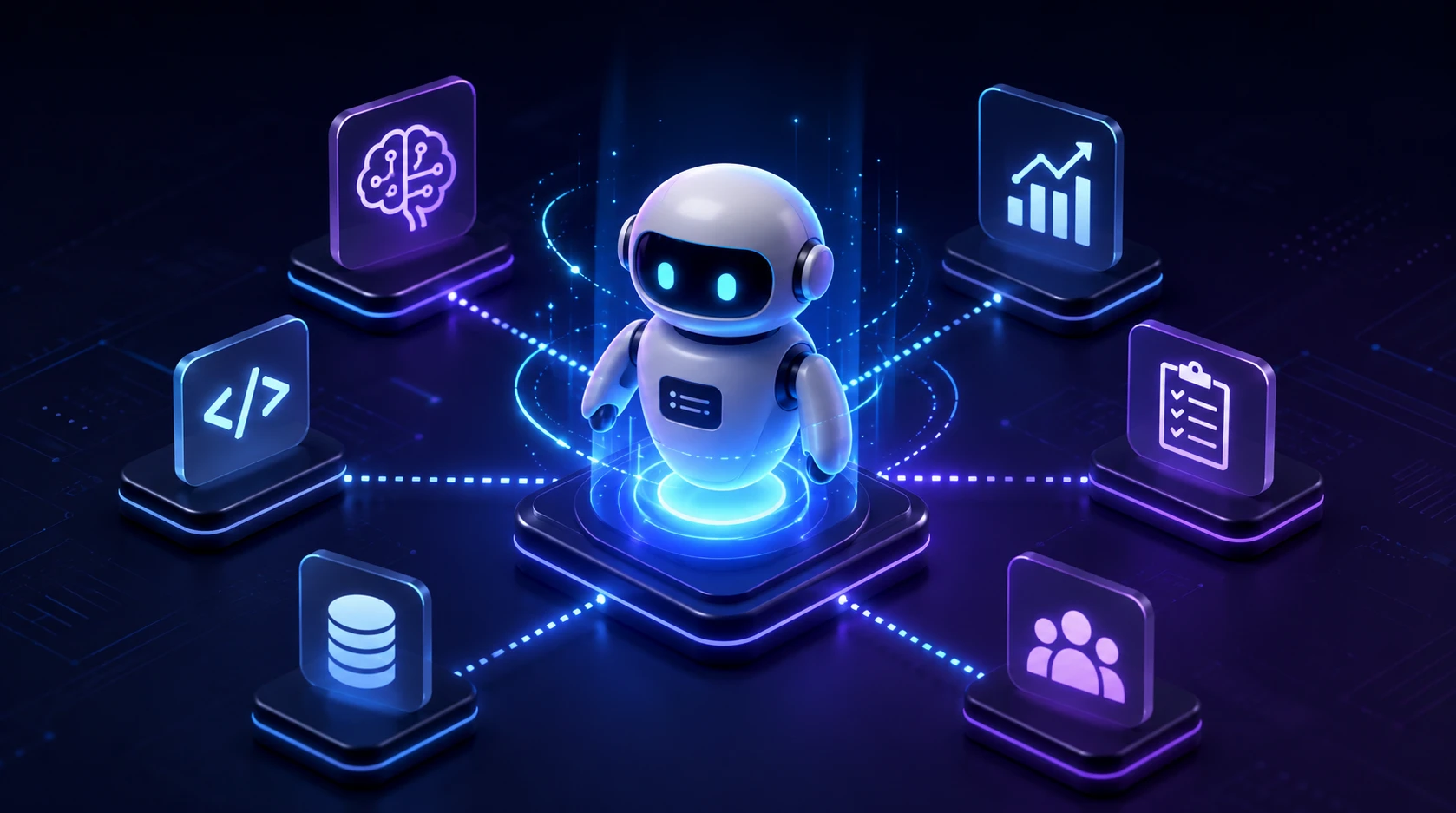
Agentic AI refers to AI systems built around agents — software entities that can perceive context, reason about a goal, plan a sequence of steps, and execute actions using tools, all with a degree of autonomy.
Unlike a simple chatbot that answers one question at a time, an agent can:
- Break a high-level goal into smaller sub-tasks
- Decide which tools or APIs to use to accomplish each sub-task
- Execute those actions in the real world (send an email, query a database, deploy code)
- Evaluate the outcome and adjust its plan if something goes wrong
In short, an agent doesn’t just generate an answer — it pursues an outcome. The “intelligence” isn’t just in producing good text; it’s in deciding what to do next and when the goal is actually complete.
Most agentic systems share a common architecture, regardless of the specific use case:
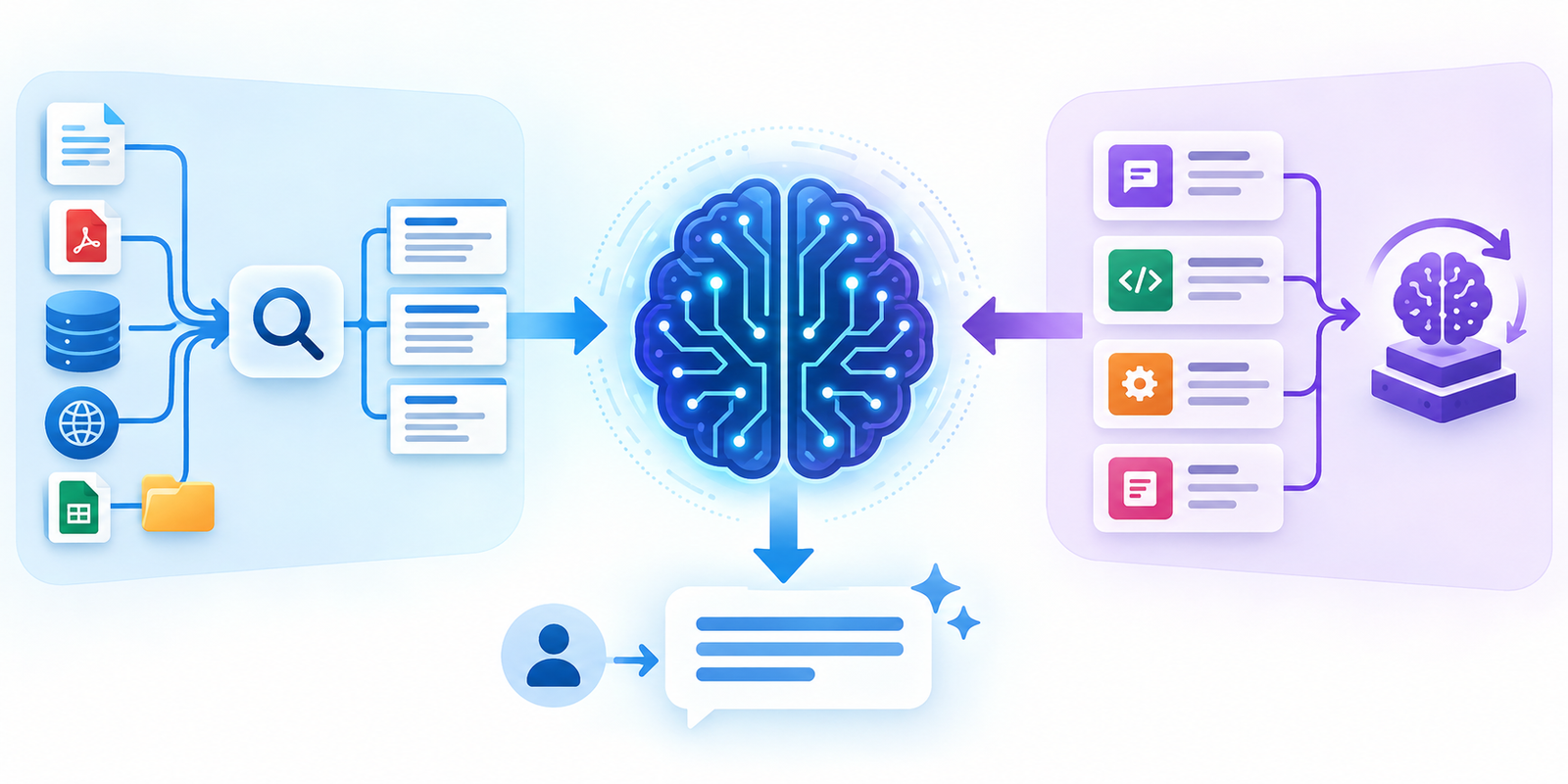
- The reasoning engine (LLM core) — the model that interprets goals and decides on next steps.
- Planning module — breaks a goal into an ordered sequence of actionable steps.
- Tool/function-calling layer — lets the agent interact with external systems: APIs, databases, browsers, code execution environments.
- Memory — short-term (within a task) and long-term (across sessions) context storage, often backed by vector databases.
- Orchestration layer — manages execution order, retries, parallel tasks, and handoffs between multiple agents.
- Guardrails and evaluation — policies, permissions, and checks that constrain what the agent is allowed to do autonomously.
Most agents operate in a repeating cycle:
- Perceive — gather relevant context: user input, retrieved documents, current system state.
- Plan — reason about the goal and decide the next best action or sequence of actions.
- Act — execute the chosen action using a tool, API call, or code execution.
- Observe — evaluate the result of the action.
- Reflect/Adjust — decide whether the goal is complete, or whether the plan needs to change and loop again.
This loop is what allows agents to handle open-ended, multi-step problems instead of just single-shot responses. For example, an agent asked to “research competitor pricing and draft a summary” would perceive the request, plan a sequence of searches, act by querying the web, observe the results, and loop back to refine its search before finally drafting the summary.
Agentic AI isn’t a single product — it’s an ecosystem of underlying models paired with orchestration frameworks that give them planning, memory, and tool access. Here are some of the most widely used building blocks in 2026:
Frontier models used as agentic “reasoning engines”:
- Claude models (Anthropic) — commonly used for coding agents and computer-use style automation, with native support for extended tool use and multi-step task execution.
- GPT-series models (OpenAI) — widely used with function calling and the OpenAI Agents SDK for building tool-using assistants.
- Gemini models (Google) — paired with Google’s Agent Development Kit (ADK) for enterprise agents built on Google Cloud and Vertex AI.
Popular orchestration frameworks:
- LangChain / LangGraph — one of the most widely adopted ecosystems, with LangGraph offering graph-based control for complex, stateful, multi-step agent workflows.
- CrewAI — a role-based framework where multiple agents are assigned distinct “jobs” (e.g., researcher, writer, reviewer) that collaborate on a shared task.
- Microsoft Agent Framework (formerly AutoGen + Semantic Kernel) — Microsoft’s unified SDK for building conversational, multi-agent systems, especially popular in enterprise .NET and Azure environments.
- LlamaIndex Workflows — a framework built around data retrieval, ideal for agents that need to stay grounded in proprietary documents or structured knowledge bases.
- Pydantic AI — a type-safe, Python-first framework favored by teams that want strict input/output validation for agent tools.
- Mastra and other newer entrants — lightweight frameworks aimed at fast prototyping of tool-using agents.
Emerging standards:
- Model Context Protocol (MCP) — an increasingly common open standard that lets agents connect to external tools and data sources (like calendars, file systems, or business apps) in a consistent, interoperable way, regardless of which underlying model or framework is used.
Choosing between these usually comes down to three questions: how complex is the workflow (simple tool use vs. multi-agent orchestration), how much control do you need over state and retries, and which cloud/model ecosystem your team already uses.
- Single-agent systems — one agent handles an entire task end-to-end, such as an AI coding assistant that writes, tests, and fixes code.
- Multi-agent systems — multiple specialized agents collaborate, each handling a sub-domain (e.g., a “research agent” gathering data and a “writer agent” drafting the output), often coordinated through frameworks like CrewAI or LangGraph.
- Human-in-the-loop agents — agents that pause for human approval before taking high-stakes or irreversible actions.
- Fully autonomous agents — agents operating with minimal oversight, typically restricted to lower-risk, well-defined domains.
- Autonomous coding agents that plan, write, test, and deploy features from a natural-language request — often built on Claude or GPT models with code execution tools.
- Research and analysis agents that gather information from multiple sources, synthesize findings, and produce structured reports.
- Customer support agents that resolve tickets end-to-end, including account changes and refunds, not just answering questions.
- Operations and workflow agents that monitor systems, detect anomalies, and take corrective action automatically.
- Personal productivity agents that manage calendars, draft communications, and complete multi-step administrative tasks.
- Handles complex, multi-step work that single-prompt AI tools can’t complete on their own.
- Reduces manual coordination by chaining tasks together without constant human hand-offs.
- Scales expertise — a well-designed agent can apply consistent judgment across large volumes of tasks.
- Operates continuously, unlike human teams bound by working hours.
- Improves over time as feedback loops refine its planning and tool use.
Agentic AI introduces new categories of risk that teams need to manage deliberately:
Key risks:
- Compounding errors — a mistake early in a multi-step plan can cascade through later steps.
- Over-permissioned actions — agents with excessive tool access can cause real-world harm (financial, data loss, reputational).
- Unpredictability — autonomous planning can produce unexpected action sequences.
- Cost and latency — multi-step reasoning and tool calls add up quickly at scale.
Best practices:
- Start with narrow, well-scoped tasks before expanding an agent’s autonomy.
- Require human approval for high-stakes or irreversible actions (payments, deletions, external communications).
- Set hard limits on tool access, spend, and action scope.
- Log and audit every action an agent takes for traceability.
- Continuously test against edge cases, not just happy-path scenarios.
- Pin framework versions and test upgrades carefully — the agentic tooling ecosystem is evolving quickly, and breaking changes are common.
Agentic AI is still early, but the trajectory is clear:
- Standardized protocols like MCP for agent-to-tool communication are making multi-agent systems easier to build and interoperate across vendors.
- Enterprise adoption is accelerating in operations, IT, and customer service, where repeatable multi-step workflows are common.
- Framework consolidation is already happening — Microsoft merging AutoGen and Semantic Kernel into a single Agent Framework is one example of the space maturing beyond fragmented early tooling.
- Regulation and governance around autonomous decision-making are likely to increase as agents take on higher-stakes responsibilities.
- Trust and reliability, not raw capability, will be the deciding factor in which agentic platforms succeed long-term.
Agentic AI represents a meaningful evolution beyond generative AI — from systems that produce content to systems that pursue outcomes. For developers and businesses, the opportunity is significant: agents can automate complex, multi-step work that was previously impossible to hand off to software. With a growing ecosystem of models (Claude, GPT, Gemini) and frameworks (LangGraph, CrewAI, Microsoft Agent Framework, LlamaIndex, and more), teams have more building blocks than ever to get started. But that power comes with real responsibility around guardrails, oversight, and trust. Teams that treat agent design with the same rigor as traditional system design — clear scope, strong permissions, and careful testing — will be the ones who get the most value from this next wave of AI.
Neha is a web technology enthusiast and content contributor at AssaptR, specializing in software development, custom web solutions, eCommerce, and digital marketing. Her articles focus on the latest industry trends, best practices, and actionable strategies that help businesses build secure, scalable, and high-performing digital products.