

JAMstack vs. Traditional Websites: Which Architecture Should You Choose in 2026?

1. Introduction

Choosing a web architecture used to mean picking a CMS and a hosting plan. Today it means deciding between two fundamentally different ways of building and serving a website: traditional, server-rendered architecture and the decoupled, pre-rendered approach popularized as JAMstack (JavaScript, APIs, and Markup).

Worth noting upfront: by 2026, the term “JAMstack” itself has faded from everyday use — the ecosystem now talks more about “headless,” “composable,” or “hybrid-rendering” architecture. But the underlying principles JAMstack introduced — decoupling the frontend from the backend, pre-rendering content, and delivering it via a CDN — are now standard practice across modern web development. This guide compares the two approaches so you can decide which model fits your project.
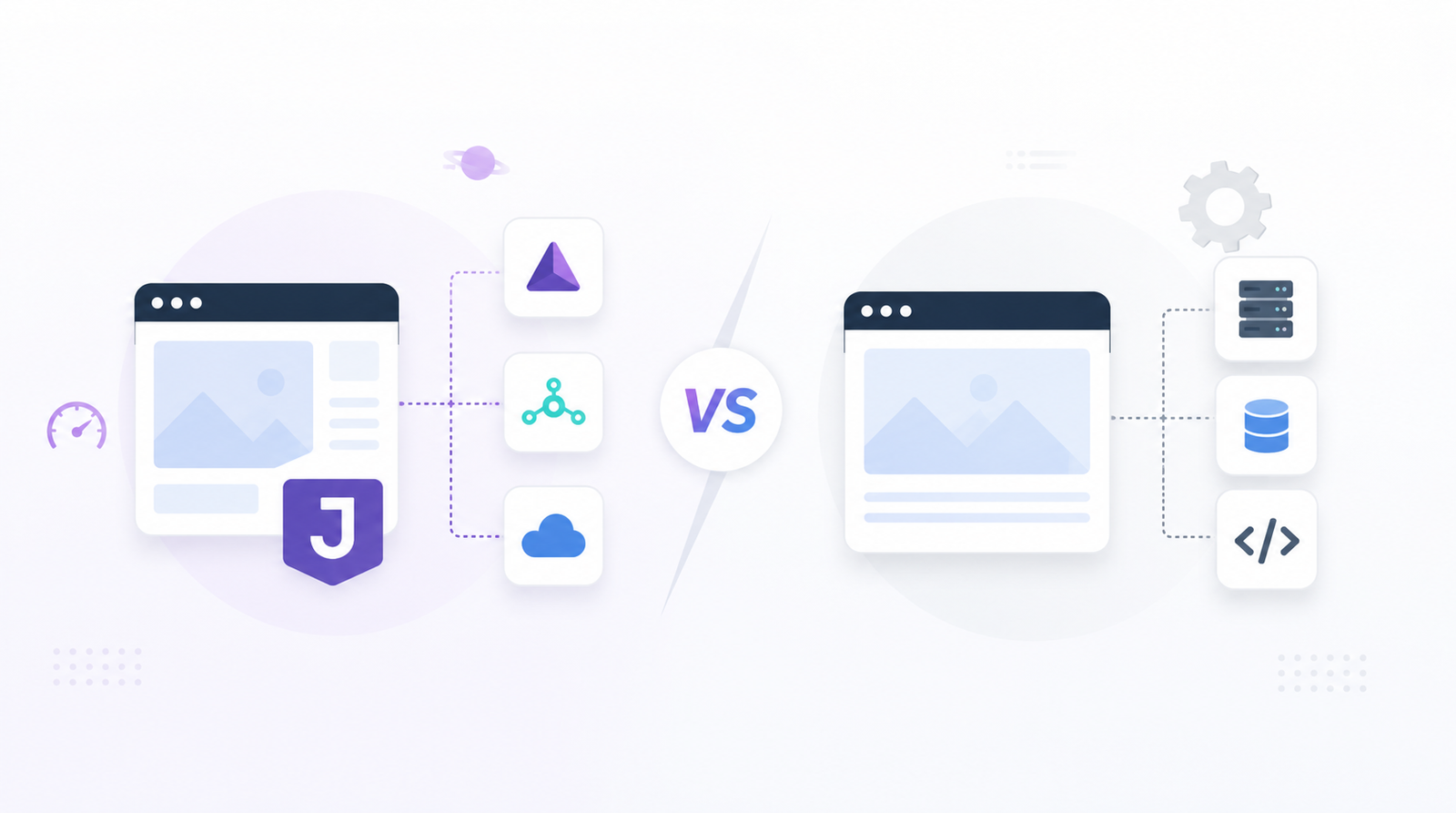
JAMstack vs. Traditional Websites

2. What Is a Traditional Website Architecture?

A traditional website (also called a monolithic or server-rendered architecture) typically runs on a CMS like WordPress, Drupal, or a custom backend where:

  • The server assembles the HTML page on every request, pulling content from a database.
  • Frontend templating, backend logic, and the database all live inside one tightly coupled system.
  • Plugins, themes, and server-side code run together, often on a single server or server cluster.

This model has powered the majority of the web for two decades and remains extremely capable, especially for content that changes constantly or requires deep backend logic.

3. What Is JAMstack Architecture?

JAMstack describes an architecture built around three principles:

  • Pre-rendering — pages are built in advance (at build time) rather than assembled on each request.
  • Decoupling — the frontend is separated from the backend; content and business logic are accessed via APIs rather than a tightly bound database layer.
  • CDN delivery — pre-built static assets are served from a global content delivery network, close to the user, instead of a single origin server.

Dynamic functionality — forms, search, authentication, checkout — is added back in through APIs and serverless functions, rather than a monolithic backend. Popular tools in this space include static site generators and hybrid frameworks like Astro, Next.js, and Nuxt, paired with headless CMSs like Sanity, Contentful, or Strapi.

4. Architectural Comparison: JAMstack vs. Traditional

Aspect Traditional Architecture JAMstack Architecture
Page Rendering Generated per request on the server Pre-rendered at build time (or hybrid/edge-rendered)
Coupling Frontend, backend, and database tightly coupled Decoupled frontend + API-driven backend
Hosting Application server required Static hosting + CDN, often serverless functions
Content Updates Instant, reflected on next request May require a rebuild or incremental regeneration
Scaling Requires server/infrastructure scaling Scales via CDN with minimal extra configuration
Attack Surface Larger — live database and server code exposed Smaller — mostly read-only static files

5. Performance Differences

Performance is one of the clearest differentiators:

  • JAMstack sites load fast because pages are already built and served from edge locations close to the user, eliminating server processing time on each request.
  • Traditional sites must query a database and render HTML on every visit, which adds latency — especially under high traffic — unless caching layers are added.
  • Because JAMstack removes render-blocking backend calls, sites often see stronger Core Web Vitals scores, which increasingly influence both user experience and search rankings.

That said, modern traditional stacks can close much of this gap using caching, CDNs in front of dynamic servers, and edge computing — so the performance advantage isn’t automatic, it’s architectural by default.

6. Security Comparison

  • JAMstack reduces the attack surface significantly: static files have no live database connection or server-side code executing per request, making common exploits like SQL injection much harder to pull off directly against the frontend.
  • Traditional architectures expose a running server and often a live database to the internet, which means security depends heavily on how well the CMS, plugins, and server are patched and maintained.
  • Neither approach is automatically secure — JAMstack sites still need to secure their APIs, serverless functions, and third-party integrations, which become the new attack surface.

7. SEO and Content Management Experience

SEO:

  • Pre-rendered, fast-loading pages tend to be easier to crawl and rank well, since search engines favor speed and consistent uptime.
  • Traditional sites can also rank well, but performance optimization requires more ongoing server-side tuning.

Content editing:

  • Traditional CMSs (like WordPress) typically offer a more familiar, all-in-one editing experience with instant publish and preview.
  • JAMstack sites usually rely on a headless CMS, which offers more flexibility for developers but can introduce a preview delay — editors may need to wait for a rebuild before seeing live changes, unless the setup supports incremental or on-demand rendering.

8. Cost and Scalability

  • JAMstack is often cheaper to host, since static files can run on free or low-cost CDN platforms, and there’s no application server to provision, patch, or scale.
  • Traditional architecture usually requires ongoing server costs, and scaling for traffic spikes means scaling infrastructure — more servers, load balancers, or a managed hosting upgrade.
  • However, JAMstack projects can accumulate hidden costs through serverless function usage, API calls, and third-party service subscriptions (headless CMS, auth providers, search services) that traditional all-in-one CMSs bundle by default.

9. When to Choose Each Architecture

Choose JAMstack (or a modern headless/composable setup) when:

  • Your site is largely content-driven — blogs, marketing pages, documentation, portfolios.
  • Performance, security, and low hosting cost are top priorities.
  • Your team is comfortable working with APIs, Git-based workflows, and modern frontend frameworks.

Choose traditional architecture when:

  • Your site needs constantly changing, highly personalized, or real-time content (dashboards, logged-in user data, live inventory).
  • Non-technical editors need a simple, instant-publish experience without rebuild delays.
  • You rely heavily on existing CMS plugins and ecosystem tooling (e.g., a mature WordPress plugin stack).

10. Conclusion

JAMstack and traditional architecture aren’t strictly “old vs. new” — they’re different trade-offs between flexibility, performance, cost, and editorial simplicity. Traditional, server-rendered systems still make sense for highly dynamic, personalized experiences and teams that want an all-in-one editing workflow. JAMstack-style, decoupled architecture makes sense when speed, security, and scalability matter most, and your team is set up to work with APIs and modern frontend tooling.

The label “JAMstack” may be fading from everyday conversation, but the architectural principles it introduced — decoupling, pre-rendering, and CDN-first delivery — have become baseline assumptions in modern web development. The real decision in 2026 isn’t “JAMstack or not,” but which rendering strategy and framework best match your content, team, and performance goals.

Neha is a web technology enthusiast and content contributor at AssaptR, specializing in software development, custom web solutions, eCommerce, and digital marketing. Her articles focus on the latest industry trends, best practices, and actionable strategies that help businesses build secure, scalable, and high-performing digital products.

Building innovative digital solutions that help businesses grow. Turning ideas into scalable technology and lasting success.