
- Services
- Services
-
- Hire a Team
-
- Industry
- Company
- Company
-
- Case Study

Your mobile app is often the closest contact a customer has with your brand. It lives on their phone, and they open it daily or delete it. A slow or clumsy app loses people fast.
Most businesses do not want to build two separate apps for iPhone and Android. That is why the React Native vs Flutter question matters so much. Both frameworks let one team build for both platforms. However, they differ in language, hiring, design, and cost.
This guide compares them in plain language. Non-technical owners get clear takeaways, and developers get the technical details that matter. By the end, you will know which framework fits your project.
Quick answer: Choose React Native if your team already knows JavaScript or React, you want the largest hiring pool, or you plan to share code with a web app. Choose Flutter if you want a highly custom, animation-rich design that looks identical on every device. Both perform well in 2026.
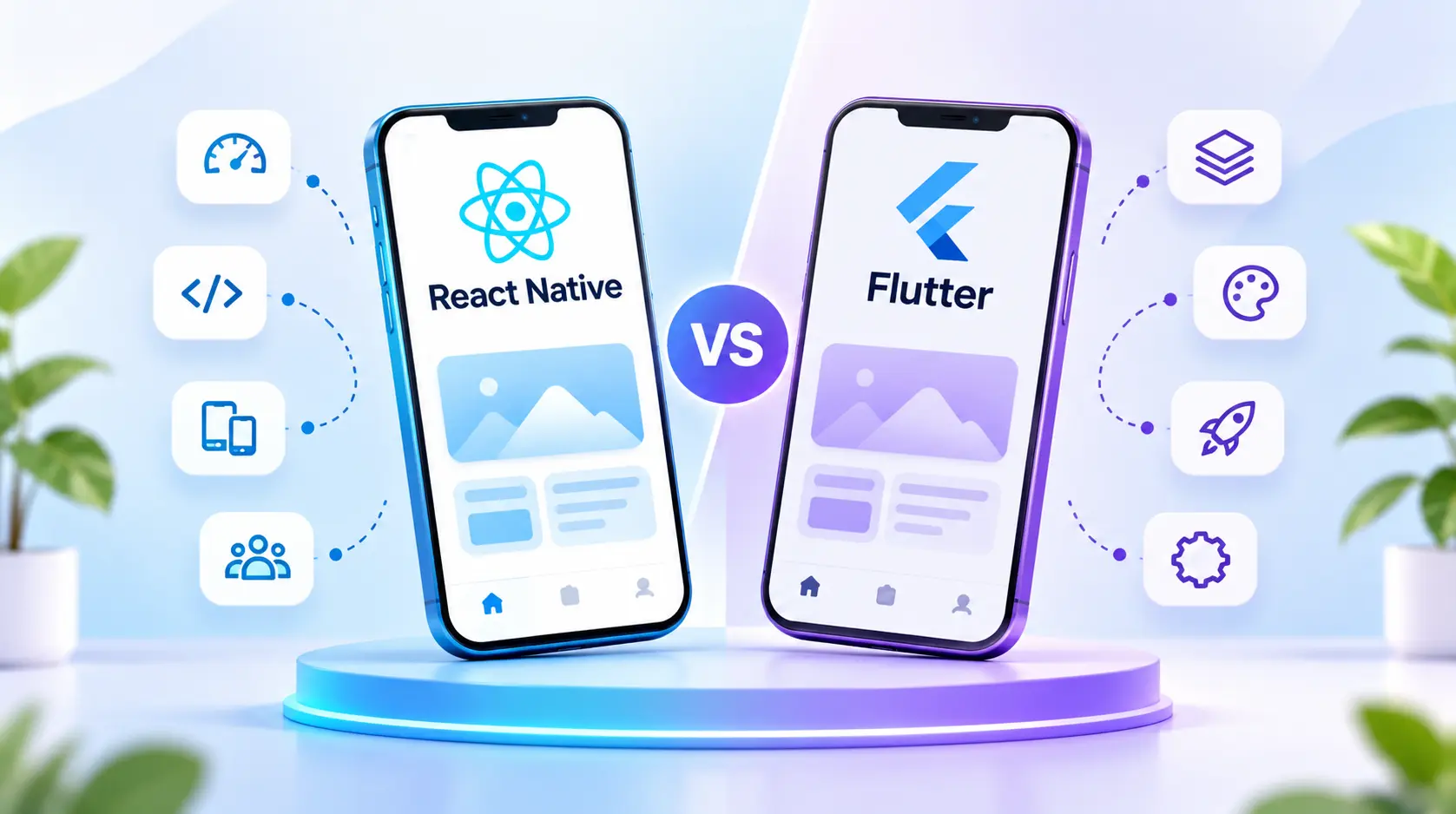
React Native is a framework from Meta for building mobile apps with JavaScript and React. It renders real native interface components on each platform. React and React Native are now governed by the new React Foundation, and Expo is the recommended way to start a project.
Flutter is a framework from Google that uses the Dart language. It draws every pixel itself with its own rendering engine. As a result, your app looks the same on every device.
Here is a simple way to picture it. React Native is like furnishing a house with each platform’s own fixtures. Flutter, on the other hand, is like bringing your own furniture to every house. The second option gives you more control. The first gives you a more familiar feel.
Learn more about AssaptR’s Mobile Application development services.
Use this table for a quick view. The sections below explain each row.
| Factor | React Native | Flutter |
|---|---|---|
| Language | JavaScript or TypeScript | Dart |
| Made by | Meta, with community governance | |
| UI approach | Native components | Custom rendering engine |
| Best for | Teams with React skills, fast hiring | Custom, animation-heavy designs |
| Learning curve | Easy for web developers | Needs a new language |
| Hiring pool | Very large | Smaller |
| Web support | Through React Native Web | Built-in web target |
| App size | Usually smaller | Usually larger |
Both frameworks have improved a lot. Older comparisons miss these updates.
The old, slow “bridge” is gone. The New Architecture became the default in version 0.76, and version 0.82 permanently disabled the legacy bridge. Moreover, version 0.84 arrived in February 2026 with Hermes V1 as the default JavaScript engine. In plain terms, React Native apps now run faster and feel smoother than they did a few years ago.
Impeller is now the default renderer on iOS and on Android API 29 and above, which removes the early-frame stutter that once affected Flutter apps. The latest stable release at the time of writing is Flutter 3.41 with Dart 3.11. In addition, stable WebAssembly compilation now supports web targets
Years ago, Flutter had a clear speed edge. That lead has shrunk. One 2026 guide says the performance gap narrowed considerably thanks to React Native’s New Architecture. Therefore, performance alone rarely decides the winner anymore.
Both frameworks run smoothly for most business apps. Think shopping, booking, banking, and delivery.
Flutter still shines in heavy graphics. One 2026 stress test measured 59 to 60 frames per second for Flutter and 54 to 58 for React Native. The same source puts launch time at about 1.1 seconds for Flutter and 1.2 seconds for React Native with Hermes. Treat these numbers as indicative, because results depend on the app and device.
App size differs too. Flutter starts about 8 to 12 MB larger because it bundles its rendering engine. For most businesses, that difference is small.
In short, both are fast enough for typical commerce and service apps. If your app needs complex animation, games, or custom charts, Flutter has a slight edge. Otherwise, pick based on your team and budget.
React Native feels familiar to anyone who knows React. Developers use JavaScript or TypeScript, hooks, and the same patterns as the web. Consequently, web teams become productive quickly. One comparison estimates two to three weeks for JavaScript developers, versus four to six weeks for developers learning Dart. techsy
Flutter requires Dart. However, many developers like it. It is statically typed, so it catches errors early. In addition, its widget-based design keeps UI code consistent.
The Same Screen in Both Frameworks
Here is a simple counter. First, React Native:
import { useState } from “react”;
import { Button, Text, View } from “react-native”;
export default function Counter() {
const [count, setCount] = useState(0);
return (
<View>
<Text>Clicked {count} times</Text>
<Button title=”Add one” onPress={() => setCount(count + 1)} />
</View>
);
}
Next, Flutter:
import ‘package:flutter/material.dart’;
class Counter extends StatefulWidget {
const Counter({super.key});
@override
State<Counter> createState() => _CounterState();
}
class _CounterState extends State<Counter> {
int count = 0;
@override
Widget build(BuildContext context) {
return Column(children: [
Text(‘Clicked $count times’),
ElevatedButton(
onPressed: () => setState(() => count++),
child: const Text(‘Add one’),
),
]);
}
}
Both are readable. React Native looks like web code, while Flutter is more verbose but very explicit.
Hiring is often the deciding factor. React Native wins here.
In the 2025 Stack Overflow survey, 66% of developers use JavaScript and 44.7% use React, while Dart sits at only 5.9%. One 2026 guide estimates roughly four to five times more React Native developers than Flutter developers worldwide. Therefore, you will usually find React Native talent faster.
Rates are similar. The same guide puts mid-level offshore rates at $40 to $60 per hour for React Native and $45 to $65 for Flutter. Flutter hiring can take longer, though Flutter engineers tend to be more specialized.
If you need extra capacity, you can explore our hire talent options or hire NextJS developers who also work in the React ecosystem. Our guide on offshore software development explains how to scale a team globally.
Design goals can tip the balance.
React Native uses real platform components. So buttons, menus, and scrolling feel native on iPhone and Android. This helps apps that should match each operating system’s habits.
Flutter draws its own widgets. Consequently, your design stays pixel-perfect and identical everywhere. This suits brands with a strong, custom visual identity.
Neither approach is better by default. Ask a simple question: should your app feel like each phone’s native apps, or like your own brand’s world? That answer often points to the right framework.
React Native taps into npm, one of the largest package ecosystems in software. The npm ecosystem gives it the broadest third-party library support of any cross-platform option. You will find ready tools for payments, maps, analytics, and chat. Large companies such as Meta, Microsoft, and Shopify use React Native at scale. adaptyriseuplabs
Flutter’s ecosystem has grown fast. Its pub.dev package site hosts over 45,000 packages. That covers most mobile needs. However, niche integrations sometimes need custom native code. adapty
For backend pairing, see our guides on Node.js vs Python for backend development and choosing a backend development company. Your app is only as strong as the APIs behind it.
Many businesses want more than phones. Here the frameworks differ.
Flutter targets Android, iOS, web, and desktop from one codebase. Its listed platforms include web, Windows, macOS, Linux, and embedded devices. That helps if you want one product across many screens. adapty
React Native focuses on mobile. It reaches the web through React Native Web, which shares code with React sites. If your web front end already uses React or Next.js, that link is valuable. Our Next.js development services show how teams share logic across web and mobile.
For web-only choices, read our comparison of React vs Vue.
Both frameworks are free and open source. Your costs come from developer time, design, testing, and upkeep.
Cross-platform development usually saves money over two native apps. The savings are significant, so most small and mid-size businesses choose one of these two frameworks.
Between them, cost differences are modest:
The real budget drivers are scope, design, integrations, and testing. For a deeper look at costs, features, and launch planning, read our guide on how to build an eCommerce mobile app.
Security depends on your practices more than your framework. Both support secure storage, biometric login, and encrypted connections.
Maintenance matters more. Both ecosystems release updates often, and old versions fall behind. For example, React Native removed its legacy architecture entirely, so apps built years ago may need migration work.
Plan for these ongoing tasks:
Also check the strength of each framework’s backer. Meta and Google both invest heavily. In addition, the React Foundation now supports React Native’s long-term governance. Neither framework looks likely to disappear.
Use these quick rules.
For online stores, either works well, and your backend choice matters more. See our Shopify development services and eCommerce web design services for connected storefronts. For finance, healthcare, and retail products, check our finance, healthcare, and retail pages. If your app includes AI features, our AI and ML services can help.
Two other paths deserve a mention.
Fully native apps use Swift and Kotlin. They give the best device access, but you build and maintain two apps. They suit products with very demanding hardware needs.
Kotlin Multiplatform shares business logic across iOS and Android while keeping native UI, and as of 2025 it can share UI too. It suits teams with strong Android and Kotlin skills. However, its ecosystem is smaller than React Native’s or Flutter’s.
For most businesses, React Native or Flutter remains the practical choice.
Skip long debates and answer these questions in order of importance.
If most answers point one way, you have your winner. When they split evenly, run the prototype and let real results decide.
Many teams repeat the same errors. Avoid these.
Neither wins every time. React Native suits teams with React skills and fast hiring needs. Flutter suits design-heavy apps and multi-platform reach. Both power real business products.
Flutter holds a small edge in heavy animation. However, React Native’s New Architecture closed much of the gap. For most business apps, users will not notice the difference.
React Native has far more available developers, because JavaScript and React skills are widespread. One guide estimates four to five times more React Native developers than Flutter developers.
Sources disagree. One guide gives Flutter about 46% of the cross-platform market and React Native about 35 to 38%. Another report puts React Native at 42%. Either way, both are widely used and well supported
Yes, but it means a rewrite of the app’s front end. Keep your backend and APIs clean and separate. Then a future switch affects only the app layer.
Usually not. Native apps cost more because you build twice. Choose them only when you need deep hardware access or top-end graphics.
The React Native vs Flutter decision comes down to your team, your design goals, and your hiring market. React Native rewards businesses with React skills and a need to hire quickly. Flutter rewards brands that want custom, consistent design across many screens.
Start with your goals and skills, then test a small prototype. A confident decision now saves months of rework later.
AssaptR builds fast, scalable apps and web platforms for growing brands. Explore our custom web development services, contact our team, or schedule a free call to plan your app.
Neha is a web technology enthusiast and content contributor at AssaptR, specializing in software development, custom web solutions, eCommerce, and digital marketing. Her articles focus on the latest industry trends, best practices, and actionable strategies that help businesses build secure, scalable, and high-performing digital products.
2. What Are React Native and Flutter?
3. React Native vs Flutter in 2026: Side-by-Side Comparison
5. Performance and User Experience
6. Learning Curve and Developer Experience
7. Hiring and Team Availability
8. UI Design and Native Look and Feel
9. Ecosystem, Libraries, and Integrations
10. Web, Desktop, and Multi-Platform Reach
12. Security, Maintenance, and Long-Term Support
13. Which Should You Choose? By Business Type
15. Other Options: Native Apps and Kotlin Multiplatform
16. A Simple Framework to Decide
WhatsApp us