- Services
- Services
-
- Hire a Team
-
- Industry
- Company
- Company
-
- Case Study

For a startup, the development partner is often the biggest early bet. The wrong choice burns your runway before you find customers. The right one helps you launch fast, learn quickly, and grow without a rewrite.
This guide shows you how to choose a SaaS development company with confidence. First, you will see what makes SaaS different from ordinary software. Next, you will learn which skills to look for, how to vet teams, and what pricing looks like. Non-technical founders get plain-language checks, and technical leads get deeper questions to ask.
Quick answer: To choose a SaaS development company, look for real SaaS products they have shipped, strong multi-tenant architecture skills, security and compliance habits, startup-friendly pricing, and full code ownership. Start with a paid discovery phase and a lean MVP, then scale. Avoid teams that quote fast, skip questions, or cannot explain their architecture.
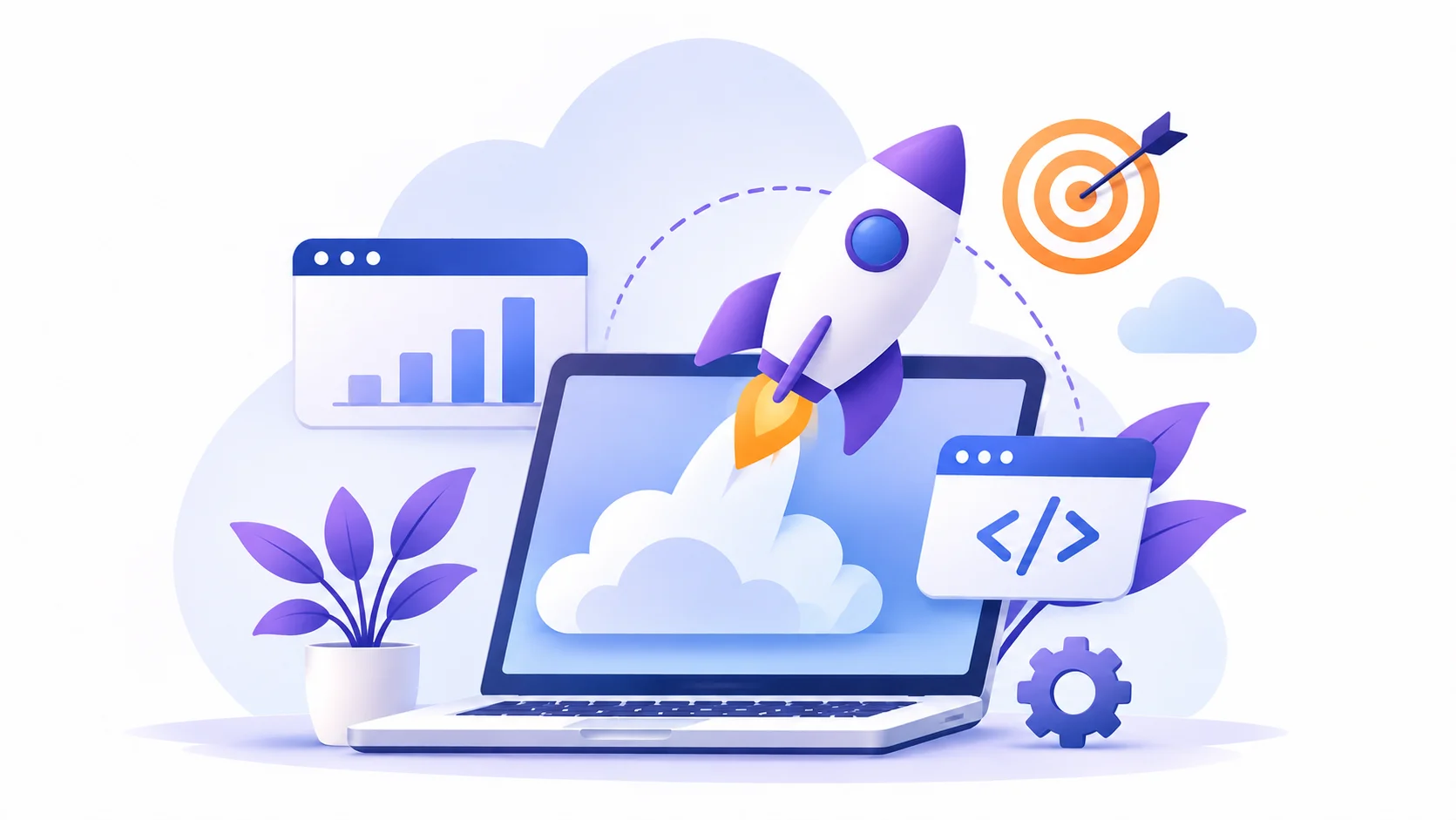
A SaaS development company designs, builds, launches, and maintains software that customers use online through a subscription. Think project tools, accounting platforms, or learning systems. Customers log in, pay monthly or yearly, and get updates automatically.
In plain terms, the company builds the product and the machinery around it. That includes accounts, billing, security, hosting, and the updates you ship every week.
What a Full-Service Partner Delivers
A strong team usually covers these areas:
Building SaaS products involves cloud infrastructure, secure data management, flexible scalability, subscription billing, and continuous maintenance for multiple users.
A SaaS product has to handle many customers on shared infrastructure, pass security reviews, and ship updates without breaking anyone’s workflow. That is harder than building a one-off app. Therefore, you need a partner who has done it before.
Multi-tenancy means many customers use one system, while their data stays separate. Teams choose between shared tables with a tenant ID, separate schemas, or separate databases. Each option trades cost against isolation. Ask any vendor which model they would pick for you, and why.
SaaS revenue depends on billing that works. That includes plans, trials, upgrades, invoices, taxes, and failed-payment recovery. Some products also charge by usage. A good partner has built this before, and often integrates a proven billing provider instead of inventing one.
Business buyers ask hard questions. They want role-based access, single sign-on, audit logs, and often a SOC 2 report. SOC 2 Type I checks your controls at one moment in time, while Type II checks them over a period. Early-stage products rarely need Type II on day one. Even so, your partner should design with it in mind.
SaaS teams ship small updates often. That needs automated tests, staged releases, and quick rollbacks. Without these habits, every release becomes a risk.
Many new products add AI features, such as summaries, search, or assistants. Check whether the team can integrate AI safely, with guardrails and cost control. Our AI and ML services and our guide on business processes you can automate using AI show what that work looks like.
Evaluate developers based on technical expertise, SaaS experience, cloud knowledge, problem-solving abilities, communication, and successful project delivery.
The best partners do more than code. They help you decide what not to build. Ask how they scope an MVP, which features they would cut, and how they validate ideas early. A team that says yes to everything is a risk.
Ask how the team designs for growth. Good answers cover modular code, caching, background jobs, database design, and scaling steps. They also avoid overbuilding, because a simple, well-structured system beats a premature microservices maze. If you are weighing data options, read our guide on the difference between SQL and NoSQL databases.
Check that the team’s stack suits your product and hiring plans. Many SaaS products use React or Next.js on the front end, with Node.js, Python, or Java on the back end. Our guides on choosing a React.js development company, Node.js vs Python for backend development, and choosing a Java development company can help. You can also see our Next.js development services.
Ask about secure coding, dependency scanning, encryption, secrets management, and access reviews. Also ask what they know about GDPR, HIPAA, or SOC 2, depending on your market.
Look for infrastructure as code, CI/CD pipelines, monitoring, alerts, and backup tests. These habits decide whether your launch week is calm or chaotic.
SaaS products win or lose in the first session. Ask how the team designs onboarding, empty states, and dashboards. Strong UX raises activation and lowers churn.
Assess a SaaS development company through its portfolio, client reviews, technical expertise, security practices, communication, and project delivery history.
Proof beats promises. Ask for live SaaS products the team built, not only websites or one-off apps. Open them, create an account, and test the experience. You can also review our own case studies to see what strong proof looks like. Industry fit helps as well, so check our pages for finance, healthcare, and retail.
A good partner proposes a short paid discovery phase. It should produce user flows, an MVP scope, an architecture sketch, and a clickable prototype. It also shows you how the team thinks, communicates, and handles pushback.
If you have a technical advisor, ask for an architecture walkthrough. Look for clear trade-offs, not buzzwords. For example, ask how they would handle tenant isolation, failed payments, and data exports.
Speak with two or three past clients, ideally startups. Useful questions include:
Some companies pitch with senior experts, then assign junior staff. Ask for short profiles of the real team, including the tech lead and QA lead. Also confirm overlap hours if the team works in another time zone. Our guide to offshore software development explains how distributed teams can work well.
Before a large contract, build one real feature together. A pilot reveals code quality, speed, and communication. It also leaves you with usable work.
Understand development expenses, pricing structures, payment terms, and contract conditions to plan your SaaS project budget effectively.
Costs vary widely, and many figures come from vendors. One 2026 guide puts a validation MVP at $15,000 to $35,000 over four to eight weeks. Another puts a lean MVP at $25,000 to $70,000, mid-complexity products at $80,000 to $200,000, and enterprise-grade platforms at $500,000 or more. A third lists MVPs at $30,000 to $80,000 and full platforms at $150,000 to $300,000 or more.
| Stage | Typical range | Typical timeline |
|---|---|---|
| Validation MVP | About $15,000 to $70,000 | 4 to 12 weeks |
| Mid-complexity product | About $80,000 to $200,000 | 3 to 6 months |
| Enterprise-grade platform | $150,000 to $500,000 or more | 6 to 12 months or more |
Treat these as ballparks. Your scope, integrations, and compliance needs decide the real price.
Rates differ by region and team model. One guide lists senior US agency rates at $150 to $250 per hour. It also notes that freelancers can cost $25 to $100 per hour, but you carry the project management, and coordination overhead can erase the savings. Clutch-listed SaaS firms in Eastern Europe and Asia often quote about $25 to $149 per hour. Quality varies, so compare process and proof, not just price.
Rates are not the full cost. Plan for these items:
Warning signs often appear early. Watch for these:
For deeper vendor vetting, see our guides on choosing a custom software development company in the USA and choosing a backend development company.
Prepare key questions and evaluation criteria to compare vendors, assess capabilities, and select the right SaaS development partner.
Bring these questions to every call:
Rate each company from 1 to 5, then multiply by the weight.
| Criteria | What good looks like | Suggested weight |
|---|---|---|
| SaaS experience and proof | Live products, startup references | 25% |
| Architecture and engineering | Clear trade-offs, multi-tenancy skill | 20% |
| Product and MVP thinking | Smart scoping, honest pushback | 15% |
| Security and compliance | Secure practices, SOC 2 awareness | 15% |
| Process and communication | Sprints, demos, named team | 10% |
| Pricing clarity | Itemized estimate with assumptions | 10% |
| Contract and support | Code ownership, warranty, handover | 5% |
Warning signs often appear early. Watch for these:
A SaaS development company builds and maintains subscription software that customers use online. That includes product strategy, design, engineering, billing, security, hosting, and ongoing support. AssaptR offers custom web development services and AI capabilities that help startups plan and build SaaS products.
Costs depend on scope, team, and compliance needs. Lean MVPs often start around $15,000 to $70,000, while mid-complexity products cost $80,000 to $200,000 or more. At AssaptR, we start with a clear scope and give you an itemized estimate. Schedule a free call to discuss your idea.
Many MVPs take four to twelve weeks, depending on scope. Mid-size products often take three to six months. A discovery phase gives you a realistic timeline.
Yes, in most cases. An MVP tests demand before you spend your full budget. Keep it focused on one core workflow, basic accounts, and one billing plan.
Not on day one for most early-stage products. However, your partner should design with security in mind, so you can pursue SOC 2 when customers ask for it.
Freelancers suit small, well-defined tasks. Agencies suit products that need design, engineering, and QA together. In-house teams suit funded companies with a long roadmap. Many startups start with an agency and hire later.
It depends on your product and team. React or Next.js on the front end, plus Node.js, Python, or Java on the back end, are common. Choose a stack your team can hire for and maintain.
AssaptR builds web platforms and backends for growing businesses. Our team covers custom web development, Next.js, Python development, mobile app development, and AI and ML services. Review our case studies before you talk to us.
Yes. If you already have a team, you can add skilled developers to it. AssaptR offers flexible options to hire NextJS developers or hire Python developers, and you can explore our wider hire talent options.
Start with a short conversation. Schedule a free call or use our contact page to share your idea, timeline, and budget range. Then we will help you shape the scope and suggest the next step.
The right SaaS development company combines real SaaS experience, sound architecture, security habits, and honest communication. Define your problem first. Then compare teams on proof, process, and price. Finally, start with a paid discovery phase and a lean MVP, so you learn before you scale.
A good partner does more than write code. They protect your runway, challenge weak ideas, and build a product that can grow with your customers.
AssaptR helps startups and growing businesses build scalable software. Explore our custom web development services, contact our team, or schedule a free call to plan your SaaS product.
Neha is a web technology enthusiast and content contributor at AssaptR, specializing in software development, custom web solutions, eCommerce, and digital marketing. Her articles focus on the latest industry trends, best practices, and actionable strategies that help businesses build secure, scalable, and high-performing digital products.
2. What Does a SaaS Development Company Do?
3. What Makes SaaS Development Different
3.1. Many Customers on Shared Infrastructure
3.3. Subscriptions, Billing, and Metering
3.4. Security, SSO, and Compliance
4. Skills and Experience to Look For
4.1. Product Thinking and MVP Discipline
4.2. Architecture and Scalability
4.3. Stack Fit and Full-Stack Skills
4.4. Security and Compliance Habits
5. How to Vet a SaaS Development Company
5.1. Look for Real SaaS Products
5.2. Start With a Discovery Workshop
5.3. Hold a Technical Conversation
5.5. Confirm Who Does the Work
6. SaaS Development Costs, Pricing Models, and Contracts
6.4. Costs Founders Often Miss
7. Questions to Ask and a Scorecard to Use

WhatsApp us