
- Services
- Services
-
- Hire a Team
-
- Industry
- Company
- Company
-
- Case Study

Off-the-shelf software works until it does not. Eventually, your workflows outgrow the tools you rent. Your team starts using spreadsheets, workarounds, and manual fixes. That is usually the moment you start looking for a custom software development company.
The choice matters because the partner you pick shapes your product, your budget, and your risk. A strong team delivers software that fits your business and grows with it. A weak team delivers late, over budget, or not at all.
This guide helps US buyers compare vendors with confidence. Non-technical owners get plain-language checks. Technical leads get deeper questions to ask. As a result, your whole team can judge each proposal fairly.
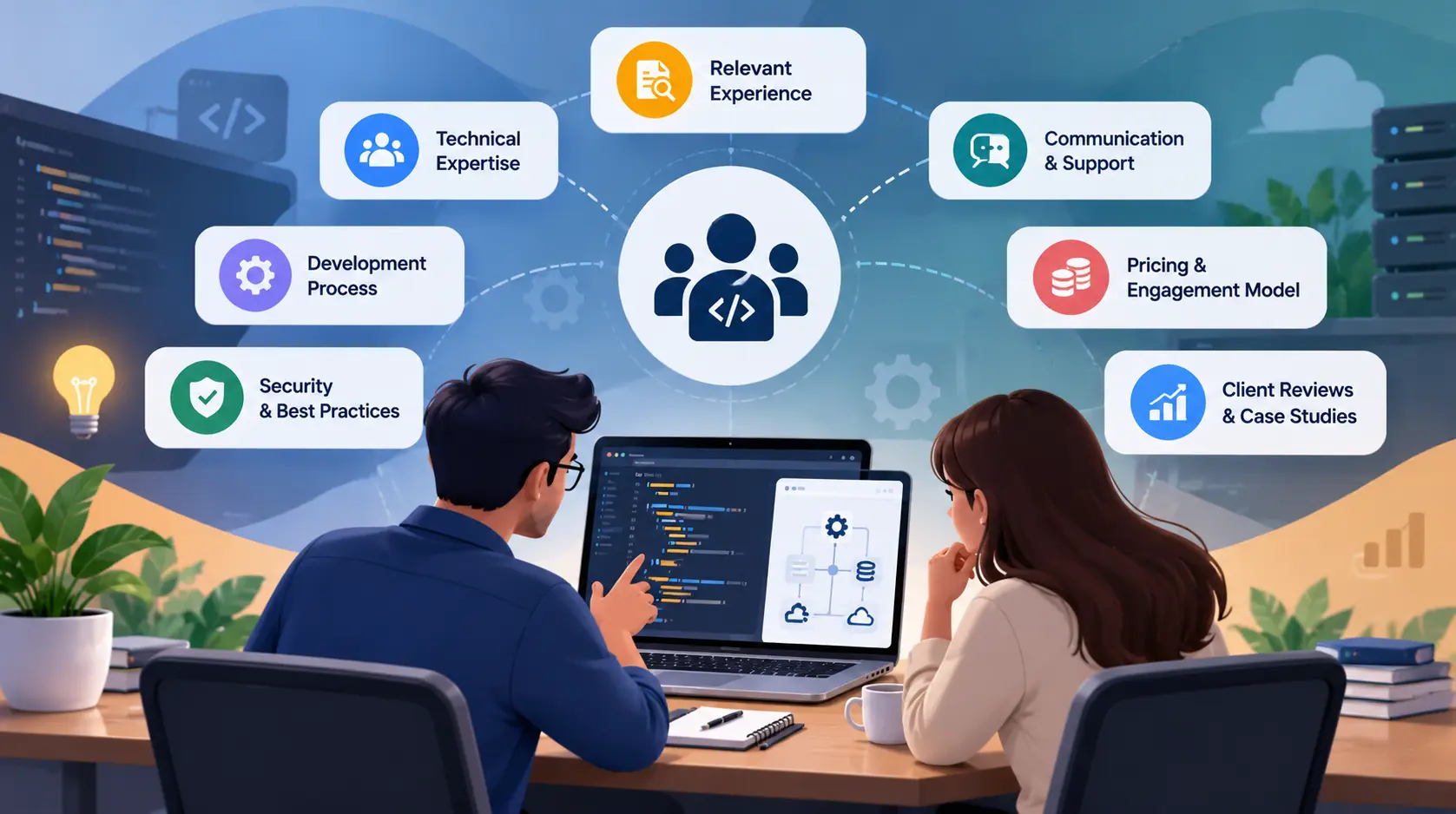
Quick answer: To choose a custom software development company in the USA, define your problem first. Then compare vendors on relevant experience, process quality, security and compliance, communication, transparent pricing, and full IP ownership. Finally, start with a paid discovery phase before signing a large contract.
A custom software development company designs, builds, tests, and maintains software made specifically for your business. Examples include customer portals, internal tools, SaaS platforms, mobile apps, integrations, and AI-powered systems.
A full-service partner usually covers:
In plain terms, a good partner acts like your outsourced product and engineering team. They do not just write code. They also challenge weak ideas and protect your budget.
Learn more about AssaptR’s Shopify development services.
Software projects fail more often from poor planning and communication than from poor code. A weak partner can cause rework, security gaps, missed launch dates, and code that no one else can maintain.
The cost of a wrong choice grows over time. For example, a poorly designed database may work for 500 users. At 50,000 users, however, it can crash. Fixing it then costs far more than doing it right the first time.
A good partner also saves time. They ship working features in short cycles. Therefore, you see progress early and can change direction before money is wasted.
US buyers usually choose among three location models. Each has trade-offs.
| Model | What it means | Best for | Main trade-off |
|---|---|---|---|
| Onshore | Team based in the USA | Regulated work, close collaboration | Highest cost |
| Nearshore | Team in Latin America or Canada | Strong time zone overlap | Mid-range cost |
| Offshore | Team in Asia or Eastern Europe | Cost efficiency, large talent pools | Less overlap, more process needed |
Onshore means hiring developers in the same country as your company, with the same time zone and culture but very high hourly rates. Nearshore teams sit between the two options. They cost less than US hiring and a bit more than offshore Asia, and the trade-off you buy is time zone overlap and easier live collaboration. teamsevenempat
Many companies blend models. Some firms combine nearshore execution with onshore leadership to balance risk, delivery speed, and governance. Our guide to offshore software development explains how distributed teams can work well when the process is strong.
Vendors can only help when your goals are clear. A vague brief leads to vague proposals and surprise costs.
For business owners: Prepare short answers to these questions:
For technical leads: Add current architecture, data volumes, expected traffic, security needs, and compliance rules.
Even a two-page brief helps. It also tests the vendor. Strong partners respond with smart questions about your business, not just a price.
Proof beats promises. So ask for evidence, not slide decks. Strong case studies explain the problem, the approach, and measurable results. Weak ones show only screenshots. You can review our own case studies to see what good proof looks like.
Then speak with two or three references directly. Useful questions include:
Also check independent review sites such as Clutch and Google. Look for patterns across many reviews, not single complaints.
A clear process separates strong teams from average ones. Ask how the team handles:
Confident teams answer with specifics. Weak teams answer with buzzwords. For deeper technical vetting, our guide on how to choose a backend development company covers APIs, databases, and infrastructure questions.
Many projects fail because of poor communication. So judge how a vendor communicates before you sign. Notice how fast they reply, whether they ask about your goals, and whether they flag risks honestly.
Ask who will actually write your code. Some vendors pitch with senior experts, then assign junior staff. Request short profiles of the real team, including your project manager, tech lead, and QA lead. Also confirm how many hours the team works in your time zone each day, and how they handle meetings across time zones.
US buyers face specific rules, so security cannot be an afterthought. Your software will hold sensitive customer and business data. Ask each vendor about:
In addition, ask about insurance. Reputable vendors carry professional liability and cyber coverage. If a vendor avoids these topics, treat it as a warning sign.
Strong contracts protect you when plans change. Read them closely, and ask a lawyer to review them. This is general guidance and not legal advice. Check these points:
Clear terms prevent lock-in. In short, you should always be able to take your software elsewhere.
Rates differ widely by source and region. One 2026 guide puts nearshore and offshore teams at roughly $25 to $99 per hour and senior onshore US teams at $100 to $250 per hour. Another puts senior US developers at $150 to $250 per hour, compared with $50 to $70 in Latin America and $25 to $45 in India. Treat these as ballparks, because quotes vary by seniority and vendor size.
A typical custom build in the US ranges from $25,000 to $250,000 or more. Another source says internal tools and workflow apps typically cost $30,000 to $80,000 and take two to four months. Complex platforms cost far more.
Rates are not the full cost. One guide advises multiplying nominal hourly cost by 1.15 to 1.30 to cover onboarding, cloud infrastructure, third-party tools, and compliance overhead. Also ask whether quotes include discovery, design, QA, project management, hosting, and post-launch support. If two quotes differ widely, one of them probably misunderstood your scope.
Launch is the start of your relationship, not the end. Before signing, confirm:
Rate each vendor from 1 to 5, then multiply by the weight.
| Criteria | What good looks like | Suggested weight |
|---|---|---|
| Technical and industry fit | Proven skills in your stack and sector | 25% |
| Case studies and references | Measurable results, reachable clients | 20% |
| Process and quality | Agile delivery, testing, CI/CD, demos | 15% |
| Security and compliance | SOC 2 or equivalent, HIPAA or PCI as needed | 15% |
| Communication and overlap | Named team, fast replies, shared hours | 10% |
| Pricing clarity | Itemized estimate with stated assumptions | 10% |
| Contract and support | IP assignment, warranty, handover terms | 5% |
Bring these questions to every vendor call:
Do not jump into a large contract. A good discovery phase usually includes workshops, user flows, a technical plan, and a clickable prototype. It costs a fraction of the full project, yet it shows you how the vendor thinks, communicates, and handles surprises.
You also keep the deliverables. Even if you choose another vendor later, the plans and prototypes still belong to you. As a result, discovery is a low-risk way to pick the right partner.
Costs vary by scope, team location, and complexity. Many projects fall between $25,000 and $250,000 or more. Hourly rates range from about $15 offshore to $250 for senior US onshore teams. At AssaptR, we start with a clear scope and give you an itemized estimate, so you can see what drives the price. Schedule a free call to get a quote for your project.
Both can work. US-based firms offer close collaboration and local legal clarity but cost more. Offshore and nearshore firms cost less and offer large talent pools. AssaptR works with clients across time zones and builds clear communication into every project. For a deeper look at the model, read our guide to offshore software development.
AssaptR builds web platforms, mobile experiences, and AI-powered products for growing businesses. Our custom web development services cover everything from architecture to launch, and our AI and ML services help you add smart features when you are ready. You can also review our case studies to see our work before you talk to us.
Compliance depends on your data and your market. Healthcare, finance, and retail products each face different rules. AssaptR serves finance, healthcare, and retail businesses. Tell us your requirements, such as HIPAA, PCI DSS, or SOC 2 expectations, and we will explain how we would approach them during your call.
Yes. If you already have a product team, you can add skilled developers to it. AssaptR offers flexible hire talent options, including Python developers and NextJS developers. This works well when you need extra capacity without a full outsourced build.
Start with a short conversation. Schedule a free call or use our contact page to describe your goals, timeline, and budget range. We will help you shape the scope and suggest the next step.
The right custom software development company combines technical depth, honest communication, strong security, and fair contract terms. Define your problem first. Then compare vendors on proof, process, and price. Finally, test the relationship with a small paid pilot.
A good partner does more than write code. They protect your budget, flag risks early, and build software that supports your growth.
AssaptR builds scalable web, mobile, and AI-powered products for growing businesses. Explore our custom web development services, browse our hire talent options, contact our team, or schedule a free call to discuss your project.
Neha is a web technology enthusiast and content contributor at AssaptR, specializing in software development, custom web solutions, eCommerce, and digital marketing. Her articles focus on the latest industry trends, best practices, and actionable strategies that help businesses build secure, scalable, and high-performing digital products.
2. What Does a Custom Software Development Company Do?
3. Why the Right Software Partner Matters
4. Onshore, Nearshore, or Offshore: Which Fits Your Project?
5. Define Your Requirements and Check Technical Fit
6. Review Proof, Process, and Communication
7. Check Security, Compliance, and Contracts
8. Compare Pricing, Costs, and Support Terms
9. Scorecard, Questions, and Red Flags

WhatsApp us