
- Services
- Services
-
- Hire a Team
-
- Industry
- Company
- Company
-
- Case Study

Choosing between Drupal Commerce vs Shopify is a big decision. The right platform depends on how complex your store is. It also depends on your budget and your technical team.
The short answer: Choose Shopify if you want a managed platform and a fast launch for a standard store. Choose Drupal Commerce if you need custom pricing, complex workflows, or deep content and commerce integration. Neither platform is better for everyone.
This guide compares both platforms fairly. We cover features, SEO, costs, and complex requirements. You will also find a decision matrix and a cost example along the way.
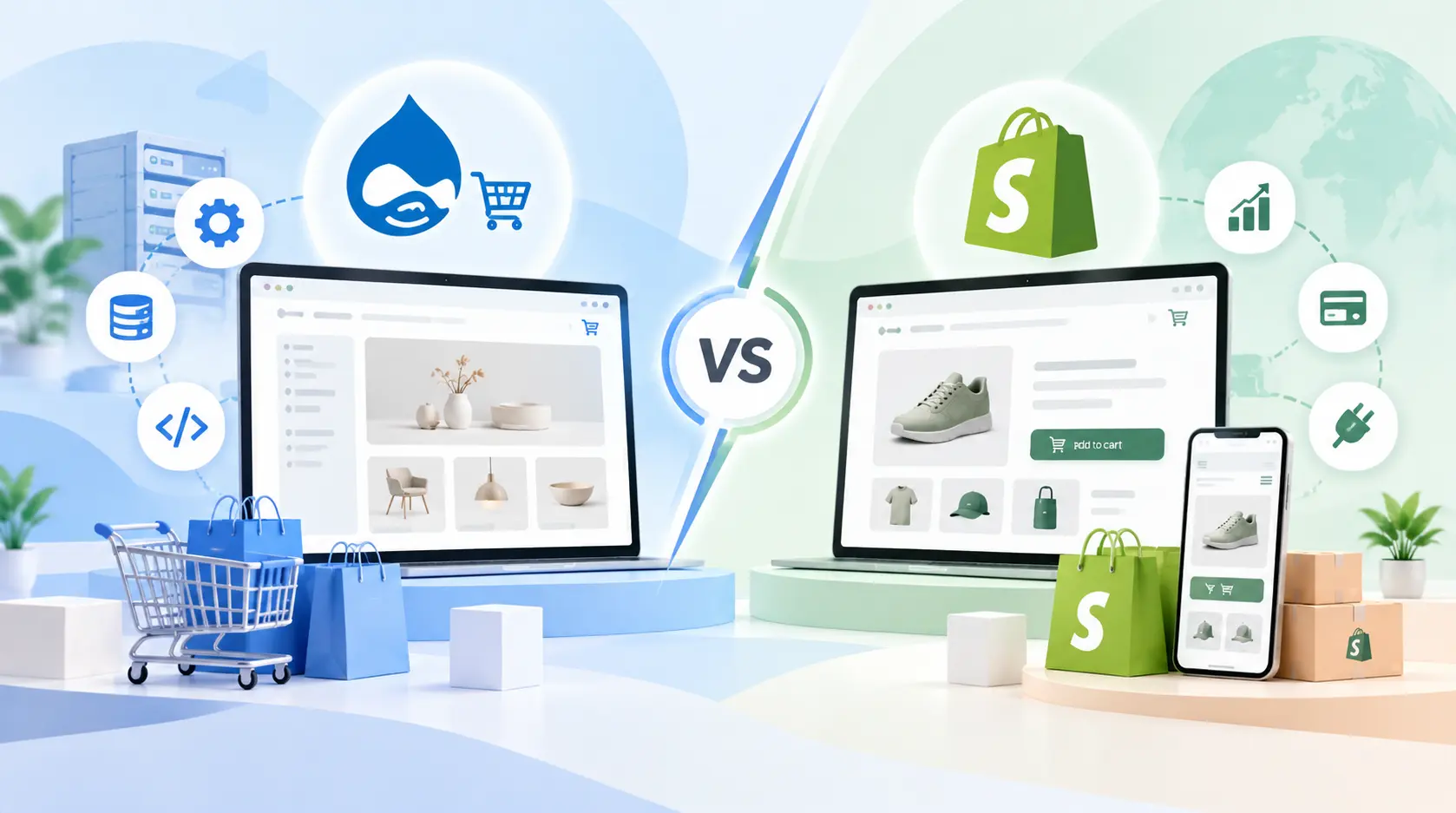
Shopify is a hosted platform. It handles hosting, security updates, and core store tools for you. That makes it a strong choice for many standard stores.
Drupal Commerce is an open-source commerce framework built on Drupal. It gives your developers full control over product models, checkout, and business rules. That makes it a strong choice for complex stores.
In short, Shopify trades flexibility for speed. Drupal Commerce trades speed for flexibility.
Learn more about AssaptR’s Shopify development services.
Drupal Commerce is a set of modules that adds eCommerce features to Drupal. Because it is open source, you can inspect and extend the code. You can also host it wherever you like.
According to the official Drupal Commerce documentation, the framework offers configurable product models and an extensible architecture. In practice, this means you can:
Drupal Commerce usually works best with an experienced team. If you need help, our Drupal development services cover planning, build, and support
Shopify is a hosted eCommerce platform. You pay a subscription, and Shopify runs the infrastructure. It also provides built-in tools for products, orders, payments, and shipping.
You can add features through the Shopify app ecosystem. Developers can also use its APIs to build custom solutions. Some advanced capabilities depend on your plan, so check the official Shopify pricing page before you decide.
Many non-technical teams can manage a Shopify store on their own. That is a real advantage for standard catalogs. If you go this route, read our guide to choosing a Shopify development partner or explore our Shopify development services.
The table below shows the main differences. These are general distinctions, not universal rankings.
| Factor | Drupal Commerce | Shopify |
|---|---|---|
| Platform model | Open-source commerce framework | Hosted commerce platform |
| Custom business logic | Highly configurable through Drupal and custom development | Customizable through platform features, apps, APIs, and eligible plans |
| Content management | Deep integration with Drupal's content architecture | Store content managed through Shopify's platform |
| Hosting and infrastructure | Your team's or implementation partner's responsibility | Managed by Shopify |
| Maintenance | Needs updates, monitoring, and technical support | Shopify manages core infrastructure; you still maintain store settings and apps |
| Integrations | APIs plus contributed or custom Drupal modules | App ecosystem and APIs |
| Technical expertise | Usually benefits from Drupal developers | Manageable by non-technical users for many standard needs |
| Best fit | Tailored content and commerce architecture | Managed platform and faster standard-store setup |
Actual suitability depends on your requirements, the quality of the build, and your ongoing cost.
Neither platform guarantees better rankings. Rankings depend on your content, your site speed, and your technical setup. Still, each platform handles SEO tasks differently.
Here is what to check on both:
Shopify covers many SEO basics out of the box. Drupal Commerce offers more freedom to shape URLs, content models, and structured data. However, that freedom needs skilled setup.
Our eCommerce SEO services can help you plan these steps for either platform.
Do not compare platform fees alone. The total cost of ownership includes several parts:
Shopify often has lower upfront costs for a standard store. It also has recurring subscription and app fees. Drupal Commerce has no license fee. However, it usually needs more development and hosting investment.
For a simple catalog, Shopify is often cheaper over time. For a complex store, custom work on Shopify can add up quickly. In that case, Drupal Commerce may offer better long-term value.
Example cost model
Use this simple formula to compare both options over three years:
Three-year cost = build + hosting + licenses and apps + integrations + maintenance
Fill in your own quotes for each item. Then compare the totals side by side. Costs vary widely, so this exercise is more useful than any fixed number.
Note: this model excludes marketing, payment processing fees, and internal staff time.
Complexity is where the two platforms differ most. Consider these scenarios.
Custom pricing. Drupal Commerce lets developers build tailored pricing rules, such as contract prices or tiered discounts. Shopify can handle many pricing needs, but advanced rules may need apps or a higher plan.
Multiple product types. Drupal’s content architecture handles very different products well. For example, you can sell physical goods, subscriptions, and event tickets with different fields.
Specialized workflows. Approval flows, custom checkout steps, and role-based permissions are natural fits for Drupal. Shopify can support some of these through apps and APIs.
Multilingual stores. Drupal has strong multilingual features built in. Shopify also supports multiple languages, so compare both against your market list.
System integrations. Both platforms connect to ERP, CRM, and other tools. Drupal gives you more control over how data flows. Shopify offers faster setup through prebuilt apps.
If your store matches several of these scenarios, talk to our team about your requirements. You can also browse our case studies to see how we approach complex builds.
AI search tools favor clear, accurate, well-organized content. Drupal Commerce can support this goal, but it does not rank better by default.
These practices help on any platform:
Drupal’s flexible content model makes structured information easier to manage. Still, results depend on your execution. For a deeper look, read our guide on how to get cited by ChatGPT and Perplexity in 2026.
Choose Drupal Commerce if:
Choose Shopify if:
Quick decision matrix
| Your priority | Better fit |
|---|---|
| Fastest launch | Shopify |
| Maximum customization | Drupal Commerce |
| Lowest technical overhead | Shopify |
| Complex B2B logic | Drupal Commerce |
| Content-rich commerce experience | Drupal Commerce |
It depends on your needs. Drupal Commerce suits enterprises with complex pricing, workflows, and integrations. Shopify suits enterprises that want a managed platform and standard features. Neither is universally better, so match the platform to your requirements and team.
The software is open source, so there is no license fee. However, you still pay for development, hosting, maintenance, and integrations. Always compare the total cost of ownership, not only the license.
Drupal Commerce generally offers deeper customization because you control the code. Shopify allows customization through apps, APIs, and theme editing. The right level depends on how unique your business rules are.
Shopify is usually easier because it manages hosting and core updates. Drupal Commerce needs regular updates, monitoring, and technical support. With a good support partner, Drupal maintenance becomes predictable.
Yes, it can be. Drupal gives you strong control over URLs, metadata, and structured data. However, no platform guarantees rankings. Results depend on content quality, speed, and technical setup.
Yes. Drupal Commerce connects to ERP and CRM tools through APIs and contributed or custom modules. The effort depends on the systems involved and how your data must sync.
Yes. A migration usually covers products, customers, orders, and URLs. Plan redirects carefully to protect your search visibility. You can hire Drupal developers to plan and run the move.
Drupal Commerce is often a strong fit for complex B2B needs. Examples include contract pricing, approval workflows, and role-based access. Shopify can serve simpler B2B models, so review your requirements first.
The best choice in the Drupal Commerce vs Shopify debate depends on your store. Shopify is ideal for managed, standard stores that need a quick start. Drupal Commerce is ideal for complex stores that need flexibility and control.
Start by listing your requirements. Then estimate your three-year costs. Finally, test both options against your most complex use case.
Ready to plan your eCommerce architecture? Explore our Drupal development services or contact AssaptR for an honest recommendation.
Neha is a web technology enthusiast and content contributor at AssaptR, specializing in software development, custom web solutions, eCommerce, and digital marketing. Her articles focus on the latest industry trends, best practices, and actionable strategies that help businesses build secure, scalable, and high-performing digital products.
2. Drupal Commerce vs. Shopify: The Short Answer
5. Drupal Commerce vs. Shopify: Feature Comparison
6. Which Platform Is Better for eCommerce SEO?
7. Drupal Commerce vs. Shopify: Cost Comparison
8. Which Platform Is Better for Complex eCommerce Requirements?
9. Can Drupal Commerce Support AI Search Optimization?
10. When Should You Choose Drupal Commerce or Shopify?
WhatsApp us