
- Services
- Services
-
- Hire a Team
-
- Industry
- Company
- Company
-
- Case Study

Online education has evolved far beyond simple course management. Today, educational institutions, corporate training providers, universities, and eLearning businesses need flexible learning platforms that integrate seamlessly with existing systems while delivering personalized experiences. This is where Laravel LMS integration becomes a powerful solution.
Laravel is one of the most trusted PHP frameworks for building secure, scalable, and feature-rich web applications. When combined with leading open-source Learning Management Systems (LMS) such as Moodle, Canvas, and Chamilo, it enables developers to extend LMS functionality, automate workflows, improve data management, and create custom learning experiences without rebuilding an entire education platform from scratch.
Whether you’re developing a custom student portal, synchronizing user data, building advanced reporting dashboards, integrating third-party applications, or creating enterprise-level education solutions, Laravel provides the flexibility needed to connect multiple systems through APIs, webhooks, microservices, and custom modules.
In this guide, you’ll learn the best methods for integrating Laravel with open-source LMS platforms, compare different integration approaches, explore security and performance best practices, and discover practical implementation strategies for building scalable educational applications.
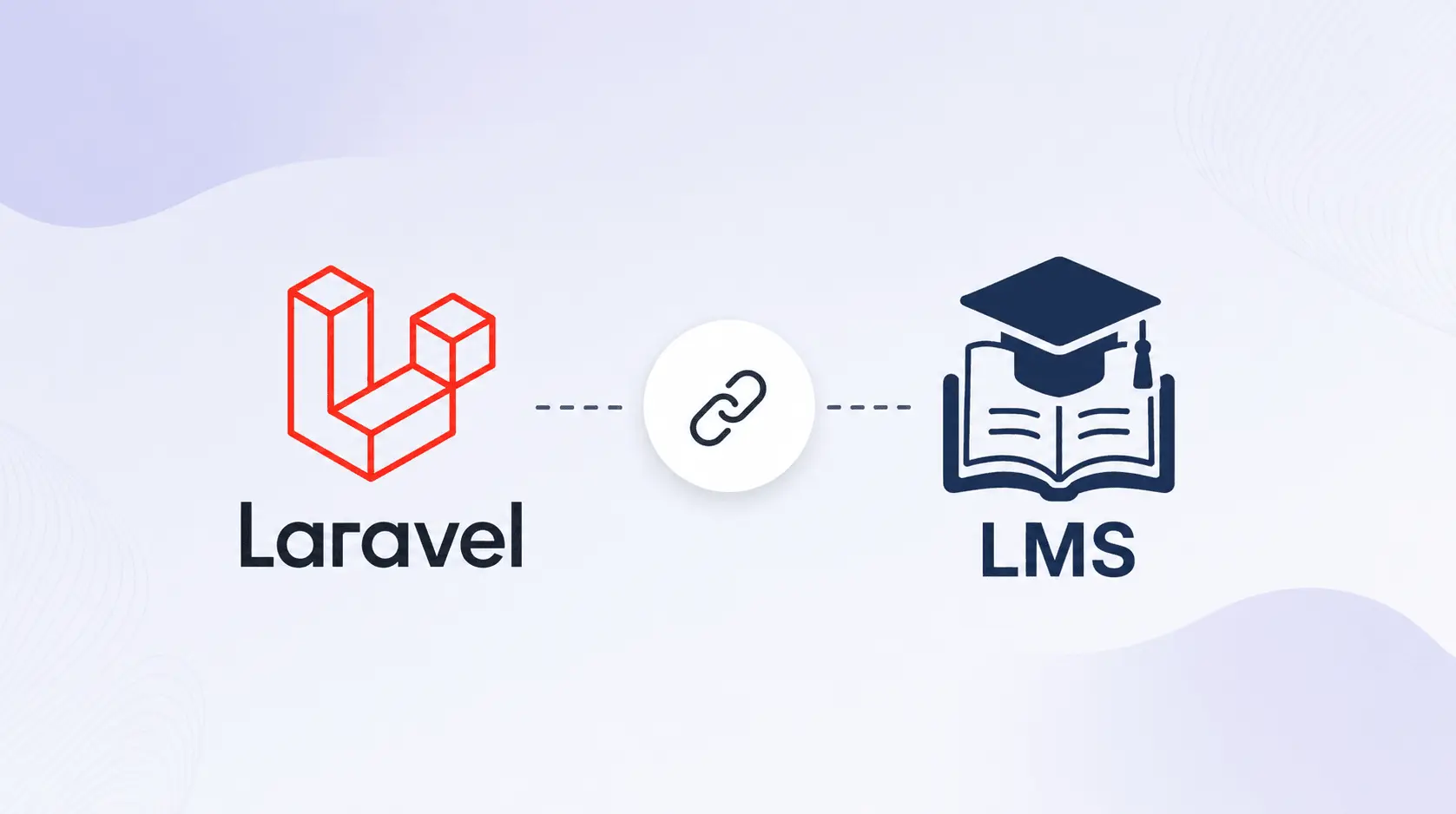
Laravel LMS integration is the process of connecting a Laravel application with an existing Learning Management System to extend its capabilities without modifying the LMS core.
Instead of replacing platforms like Moodle or Canvas, Laravel works alongside them to add custom business logic, automate repetitive tasks, improve user experiences, and integrate external services.
Common integration use cases include:
This approach allows organizations to retain the stability of their LMS while leveraging Laravel’s modern development ecosystem for rapid customization and scalability.
Open-source LMS platforms offer robust learning management features, but every institution has unique operational requirements. Laravel bridges this gap by enabling developers to build tailored solutions that improve functionality without compromising system stability.
Laravel allows developers to implement custom workflows, dashboards, APIs, and business logic that are difficult or impossible to achieve using default LMS features.
Most modern LMS platforms expose REST APIs, making it simple for Laravel applications to exchange data such as user profiles, course information, grades, assignments, and learning progress.
Custom Laravel frontends provide faster performance, responsive interfaces, personalized dashboards, and intuitive navigation while maintaining seamless communication with the LMS backend.
Laravel’s modular architecture enables organizations to scale applications efficiently as the number of students, instructors, and courses grows.
Built-in protection against SQL injection, CSRF, XSS attacks, secure authentication, encrypted sessions, and role-based access controls make Laravel ideal for handling sensitive educational data.
Laravel simplifies connections with services like:
Not every LMS offers the same integration capabilities. Below are the most popular platforms that work effectively with Laravel.
| LMS Platform | API Support | Best For | Integration Difficulty |
|---|---|---|---|
| Moodle | REST API, Web Services | Universities, Schools | Easy |
| Canvas LMS | REST API, LTI | Higher Education | Easy |
| Chamilo | REST API | Corporate Training | Medium |
| Open edX | REST API | MOOCs | Medium |
| ILIAS | SOAP & REST | Government, Enterprise | Advanced |
Neha is a web technology enthusiast and content contributor at AssaptR, specializing in software development, custom web solutions, eCommerce, and digital marketing. Her articles focus on the latest industry trends, best practices, and actionable strategies that help businesses build secure, scalable, and high-performing digital products.
WhatsApp us